Today's
EarthStation1.com 15% Off Commemorative Memorial Title: Hansel And
Gretel (1954) Engelbert Humperdinck Opera DVD MP4 USB Drive
Today, June 5, 2026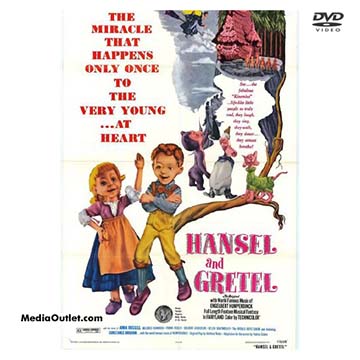
June 5: National Gingerbread Day: -- A
day gingerbread lovers across the country celebrate by sampling
their favorite recipes and gingerbread treats. Whether in the form
of bread, cakes, bars, biscuits, or cookies, they're delicious any
time of year. The term "gingerbread" originally referred
to preserved ginger, later referring to a confection made up of
honey and spices. Gingerbread is a sweet food that typically uses
honey or molasses rather than just sugar and is flavored with
ginger. Gingerbread foods range from a soft, moist loaf cake to
something closer to a ginger biscuit. It is believed that
gingerbread was first brought to Europe in 992 by an Armenian
monk. He lived there for seven years teaching gingerbread cooking
to the French priests and Christians until his death in 999.
Sources indicate that in 1444, Swedish nuns were baking
gingerbread to ease indigestion. In the 17th century, gingerbread
biscuits were sold in monasteries, pharmacies and town square
farmers markets. During the 18th century, gingerbread became
widely available. To observe National Gingerbread Day: Break out
your favorite gingerbread recipe; Visiting your local bakery; Pick
out a variety of gingerbread treats to share: Give your bakery a
shout out, too; Enjoy Old Fashioned Gingerbread, Gingerbread
Pancakes with Fruit Topping and/or Gingerbread-Cupcakes; and use
#NationalGingerbreadDay to post on social media. On Sale @ 15% Off
Discount Till Midnight PT!
https://store.earthstation1.com/hansel-and-gretel-an-opera-fantasy-dvd-1954-stop-motion-anim1954.html
Today's
EarthStation1.com 15% Off Commemorative Memorial Title: Yours
Truly Johnny Dollar Radio Series MP3 DVD, Download, USB Drive
Today, June 5, 2026
June 5: National Moonshine Day: --
Recognizes a beverage with a notorious record of blurring the
lines of history and the law, turning ordinary men (and women)
into criminals and common criminals into legends. Moonshine
traditionally is an illegally distilled spirit. Mostly made from a
corn mash, moonshine is a distilled whiskey that is typically
produced by an individual illegally without a permit. Also known
as white lightning, mountain dew, homebrew, hillbilly pop, rotgut,
and many more. Distilling skills first came to the United States
with the Scotch-Irish as they settled in Virginia. Temperance laws
and prohibition legislation were passed in several states before
the Civil War, but it wasn't until the turn of the century that
the temperance movement picked up steam. By the time the 18th
Amendment was ratified early in 1919, over half the country was
dry. Prohibition lasted 13 years. It created a demand for
moonshine, and distilling and distributing it became big business
overnight. These days, moonshine in the legal sense has a
following. Small-batch distilleries are producing legal moonshine
giving moonshiners a new name. Bringing moonshine out of the woods
and going up against other whiskeys for a place on the shelf. Many
are packaging their homebrews in canning jars, embracing their
rich history while at the same time experimenting with flavor and
branching out with food pairing similar to that of wine and beer.
To observe National Moonshine Day, share your favorite whispered
histories of the white lightning and the legendary people who made
it and chased it' drink responsibly and use #NationalMoonshineDay
to share on social media. On Sale @ 15% Off Discount Till Midnight
PT!
https://store.earthstation1.com/yours-truly-johnny-dollar-old-time-radio-dual-layer-mp3-dv3.html
Today's
EarthStation1.com 15% Off Commemorative Memorial Title: The Old
Time Radio History MP3 MegaSet DVD, Audio Download, USB Drive
Today, June 5, 2026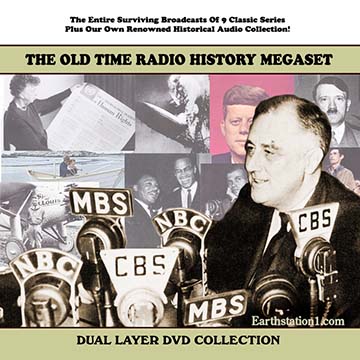
June 5: Hot Air Balloon Day: -- Today's
celebrations range from taking a hot air balloon flight, going
through the historical facts, and, of course, learning some basics
in case you aspire to become a hot air balloon pilot someday. Did
you know that the hot air balloon is the oldest form of aviation?
Although not as advanced as they are today, they've been around
since the 18th century, which was a time when appreciating the
beautiful landscapes from above with a helicopter wasn't an
option. Flying in a hot air balloon is one of the most adventurous
ways of appreciating the science behind them and seeing the world
from a different point of view. Although the celebration of Hot
Air Balloon Day dates back about a decade, the history of hot air
balloons traces back to ancient Chinese culture and military
tactics, where airborne lanterns were released in the air as a
cultural practice and military signal respectively. Two brothers,
Joseph-Michel and Jacques-Etienne Montgolfier invented the hot air
balloon in France and flew it for the first time in 1783. They
publicly demonstrated the flight, which lasted for 10 minutes and
had only animals on board. A few months later, Jean Francois
Pilatre de Rozier became the first human to take a hot air balloon
ride. In the 1950s, Paul Edward Yost, an American who invented the
modern-day hot air balloon, advanced the way hot air balloons
operate. His invention saw the addition of a propane burner engine
to the hot air balloon which generates and pumps through the mouth
of the envelope (balloon). During the test, the balloon flight
lasted for an hour. Hot Air Balloon Day presents an opportunity to
glorify this mode of aviation and to increase awareness of flight
transportation. Hot air ballooning is currently used
recreationally, even though inaccessible to many. It has also been
customized into different shapes, sizes, and beautiful colors. On
Sale @ 15% Off Discount Till Midnight PT!
https://store.earthstation1.com/the-old-time-radio-history-megaset-dual-layer-mp3-dv3.html
Today's
EarthStation1.com 15% Off Commemorative Memorial Title: America:
The Second Century Documentary Series DVD, Download, USB
Today, June 5, 2026
June 5: World Environment Day: -- Urges
all of us to protect our natural surroundings. The stunning facts?
An estimated 7 million people die each year from causes related to
air pollution, with a majority occurring in the Asia-Pacific
region. This day encourages worldwide activism. That means
everything from littering to climate change. World Environment Day
is both a global celebration and a platform for public outreach.
The UN first established World Environment Day in 1972. World
Environment Day (WED) is one of the more unique and special
holidays because of its history and its many firsts. It was
created on the first day of the first-ever U.N. conference which
focused on humans and how they interact with the environment.
However, this didn't happen overnight. Sweden first suggested
having such a conference to the U.N. way back in 1968. And in
1969, the U.N. agreed that after 3 years they would have a
conference in Sweden that focused on environmental issues.
Interestingly enough, the conference was led by Maurice Strong, a
Canadian diplomat who worked in the oil and mineral industry, who
also had a soft spot for the environment. Finally, it all came
together in 1972, after 4 years of preparations and 30M USD later.
World leaders from around the world sat together to discuss how
they can raise awareness to protect our environment - and it was
then WED was made. Then 2 years later, the first-ever WED was
celebrated with the slogan "Only One Earth." Ever since
then, WED has been completely embraced by people everywhere, so
much so that it's even slowly creeping into pop culture (and we
love it!) Celebrities around the world all encourage people, in
their own unique way, to do their part and " save the world".
Fan-favorites Leonardo DiCaprio and Meryl Streep are some of the
many who constantly speak out about environmental awareness. So,
it doesn't matter if you're a famous actor, an athlete or a
student in college: gather your friends and spend a day outdoors
doing fun activities towards preserving this beautiful planet.
Believe us when we say, you'll have a blast and feel so much
better afterward. On Sale @ 15% Off Discount Till Midnight PT!
https://store.earthstation1.com/america-the-second-century-us-2nd-100-years-history-621006.html
Today's
EarthStation1.com 15% Off Commemorative Memorial Title: The French
Revolution Series + Irish Rebellion & You Are There MP4 DVD
Today, June 5, 2026
June 5, 1798: May 24, 1798: The Age Of
Enlightenment (The Enlightenment, The Age Of Reason): The Age Of
Revolution: The Atlantic Revolutions: The French Revolution: The
French Revolutionary And Napoleonic Wars (The Great French War)
(The French Revolutionary Wars, The Napoleonic Wars): The
Napoleonic Wars: The Irish Rebellion Of 1798 (Irish: Eiri Amach
1798) (The United Irishmen Rebellion [Irish: Eiri Amach Na
nEireannach Aontaithe], Ulster-Scots: The Hurries): The Battle Of
New Ross: -- The attempt to spread the United Irish Rebellion into
Munster is defeated. The Battle Of New Ross took place in County
Wexford in south-eastern Ireland, during the Irish Rebellion Of
1798. It was fought between the Irish Republican insurgents called
the United Irishmen and British Crown forces composed of regular
soldiers, militia and yeomanry. The attack on the town of New Ross
on the River Barrow, was an attempt by the recently victorious
rebels to break out of county Wexford across the river Barrow and
to spread the rebellion into county Kilkenny and the outlying
province of Munster. The Irish Rebellion Of 1798 (Irish: Eiri
Amach 1798), also known as the United Irishmen Rebellion (Irish:
Eiri Amach na nEireannach Aontaithe), was an uprising against
British rule in Ireland lasting from May to September 1798. The
Society Of United Irishmen, a republican revolutionary group
influenced by the ideas of the American and French revolutions,
were the main organising force behind the rebellion. The outbreak
of war between Great Britain and France in 1793, following both
the succesful American Revolutionary War and the execution of the
French King Louis XVI, forced the Society underground and toward
armed insurrection, with French aid. To augment their growing
strength, the United Irish leadership decided to seek military
help from the French revolutionary government and to postpone the
rising until French troops landed in Ireland. Theobald Wolfe Tone,
leader of the United Irishmen, travelled in exile from the United
States to France to press the case for intervention. The intimate
nature of the conflict meant that the rebellion at times took on
the worst characteristics of a civil war, especially in Leinster.
Sectarian resentment was fuelled by the remaining Penal Laws still
in force. Rumours of planned massacres by both sides were common
in the days before the rising and led to a widespread climate of
fear. Contemporary estimates put the death toll from 20,000 to as
many as 50,000 of which 2,000 were military and 1,000 loyalist
civilians. A significant number of modern historians argue that
these numbers are too high or too low. In support of some modern
research argues that these figures may be too high, a list of
British soldiers killed, compiled for a fund to aid the families
of dead soldiers, listed just 530 names; also, professor Louis
Cullen, through an examination of depletion of the population in
County Wexford between 1798 and 1820, put the fatalities in that
county due to the rebellion at 6,000. Historian Thomas Bartlett
therefore argues, "a death toll of 10,000 for the entire
island would seem to be in order". In support of the belief
that the death toll may be even higher than contemporary estimates
suggest as the widespread fear of repression among relatives of
slain rebels led to mass concealment of casualties. The popular
Irish ballad The Rising of the Moon recounts the loss of the
United Irishmen. Written as early as the 1860s, the song has been
since performed by many musicians, including The Dubliners. On
Sale @ 15% Off Discount Till Midnight PT!
https://store.earthstation1.com/the-french-revolution-dvd-3-part-tv-documentary-serie3.html
Today's
EarthStation1.com 15% Off Commemorative Memorial Title: Gunsmoke
Old Time Radio Series MP3 Set DVD, Audio Download, USB Stick
Today, June 5, 2026
June 5, 1850: #BOTD: #HBD! Pat Garrett,
American Old West lawman, bartender and customs agent who became
renowned for killing Billy The Kid (d. February 29, 1908) is #born
Patrick Floyd Jarvis Garrett in Chambers County, Alabama. After
Sheriff Pat Garrett had captured Billy The Kid, known then by the
alias William H. Bonney (real name: Henry McCarty) in December
1880 at Stinking Springs, New Mexico on an arrest warrant fo
murder, Bonney was tried and convicted of the murder of Lincoln
County Sheriff William J. Brady in April 1881. He was sentenced to
hang in May of that year. He escaped from jail on April 28, 1881,
killing two sheriff's deputies in the process and evading capture
for more than two months. Garrett shot and killed Bonney, aged 21,
in Fort Sumner on July 14, 1881. On February 29, "the oddest
day of the year", 1908, Garrett himself was shot dead in Las
Cruces, New Mexico aged 57 under strange circumstances during a
wagon trip in New Mexico. Jesse Wayne Brazel, with whom Garret's
son Dudley had a contentious land lease, told Deputy Sheriff
Felipe Lucero "Lock me up. I've just killed Pat Garrett!"
Brazel then pointed to Garrett's companion on the wagon trip, Carl
Adamson, and said, "He saw the whole thing and knows that I
shot in self-defense." The site of Garrett's death is now
commemorated by a historical marker south of U.S. Route 70,
between Las Cruces, New Mexico and the San Augustin Pass. The
historical marker is located about 1.2 miles from where Garrett
was murdered. In 1940 his son, Jarvis Garrett, marked the spot
with a monument consisting of concrete laid around a stone with a
cross carved in it. The cross is believed to be the work of
Garrett's mother. Scratched in the concrete is "P. Garrett"
and the date of his killing. The marker is located in the desert.
In 2020, the city of Las Cruces revealed plans for a development
that would destroy the site. An organization called Friends of Pat
Garrett has been formed to ensure that the city preserves the site
and marker. At six feet five inches, Garrett's body was too tall
for any finished coffins available, so a special one had to be
shipped in from El Paso. His funeral service was held March 5,
1908, and he was laid to rest next to his daughter, Ida, who had
died in 1896 at the age of fifteen. Garrett's grave and the graves
of his descendants are in the Masonic Cemetery, Las Cruces.
Brazel's trial for Garrett's murder concluded on May 4, 1909.
Brazel was represented at his trial by attorney and future
Secretary of the Interior Albert Bacon Fall. The only eyewitness
to Garrett's murder, Adamson, never appeared at the trial, which
lasted only one day and ended with an acquittal. Despite his
confession, and subsequent trial, debate continues over who
actually pulled the trigger. A couple years after the killing,
Brazel married and acquired a small ranch just west of the nearby
small city of Lordsburg. In his late thirties when his wife died
in 1913, he sold the property and disappeared from public record.
The period and circumstances of his death remain unconfirmed, but
word of mouth has indicated that it may have been two years later.
A little over thirty years later, in early July 1947, his nephew
William "Mac" Brazel gained certain fame in the
so-called Roswell UFO incident when he allegedly found strange
debris on his ranch some 70 miles northwest of Roswell, sparking
the claim that a flying saucer crashed on the ranch where Brazel
was foreman. On Sale @ 15% Off Discount Till Midnight PT!
https://store.earthstation1.com/gunsmoke-mp3-dvd-complete-old-time-radio-serie3.html
Today's
EarthStation1.com 15% Off Commemorative Memorial Title: Ethnic
Notions + The Mammy Legend: Black Stereotypes DVD MP3 USB Drive
Today, June 5, 2026
June 5, 1851: The Origins Of The American
Civil War (The Civil War, The War Between The States): Events
Leading To The American Civil War: Slavery: Slavery In The United
States: First Publications: Uncle Tom's Cabin (Life Among The
Lowly): -- Harriet Beecher Stowe's anti-slavery serial Uncle Tom's
Cabin starts a ten-month run in the National Era abolitionist
newspaper. It was published as a book in 1852, and the novel
helped lay the groundwork for the Civil War. Stowe, a
Connecticut-born teacher at the Hartford Female Seminary and an
active abolitionist, featured the character of Uncle Tom, a
long-suffering black slave around whom the stories of other
characters revolve. The sentimental novel depicts the reality of
slavery while also asserting that Christian love can overcome
something as destructive as enslavement of fellow human beings.
Uncle Tom's Cabin was the best-selling novel of the 19th century
and the second best-selling book of that century, following the
Bible. It is credited with helping fuel the abolitionist cause in
the 1850s. In the first year after it was published, 300,000
copies of the book were sold in the United States; one million
copies in Great Britain. In 1855, three years after it was
published, it was called "the most popular novel of our day."
The impact attributed to the book is great, reinforced by a story
that when Abraham Lincoln met Stowe at the start of the Civil War,
Lincoln declared, "So this is the little lady who started
this great war." The quote is apocryphal; it did not appear
in print until 1896. The book and the plays it inspired helped
popularize a number of stereotypes about black people. These
include the affectionate, dark-skinned "mammy"; the
"pickaninny" stereotype of black children; and the
"Uncle Tom", or dutiful, long-suffering servant faithful
to his white master or mistress. In recent years, the negative
associations with Uncle Tom's Cabin have, to an extent,
overshadowed the historical impact of the book as a "vital
antislavery tool." On Sale @ 15% Off Discount Till Midnight
PT!
https://store.earthstation1.com/ethnic-notions-africanamerican-stereotypes-dvd.html
Today's
EarthStation1.com 15% Off Commemorative Memorial Title: Bloody
Shenandoah: The Valley Campaign Of 1864 Civil War DVD, MP4, USB
Today, June 5, 2026
June 5, 1864: The American Civil War (The
Civil War, The War Between The States): The Eastern Theater Of The
American Civil War: The Valley Campaigns Of 1864 (The Shenandoah
Valley Campaigns Of 1864): The Lynchburg Campaign: The Battle Of
Piedmont: -- Union forces under Maj. Gen. David Hunter defeat a
Confederate army under Brig. Gen. William E. "Grumble"
Jones north of the village of Piedmont, Augusta County, Virginia.
After severe fighting, Jones was killed, the Confederates were
routed and the Union took nearly 1,000 prisoners. Hunter occupied
Staunton on June 6 and soon began to advance on Lynchburg,
destroying military stores and public property in his wake. On
Sale @ 15% Off Discount Till Midnight PT!
https://store.earthstation1.com/bloody-shenandoah-valley-campaign-of-1864-civil-war-dvd-mp18644.html
Today's
EarthStation1.com 15% Off Commemorative Memorial Title: The
Mexican Revolution 1910-1920 DVD, Video Download, USB Drive
Today, June 5, 2026
June 5, 1878: #BOTD: Pancho Villa,
Mexican general in the Mexican Revolution, politician, Governor of
Chihuahua, and scoundrel (d. July 20, 1923) is #born Jose Doroteo
Arango Arambula in La Coyotada, San Juan del Rio, Durango, Mexico.
Francisco Villa, nicknamed Pancho, was a key figure in the
revolutionary movement that forced out President Porfirio Diaz and
brought Francisco I. Madero to power in 1911. When Madero was
ousted by a coup led by General Victoriano Huerta in February
1913, he joined the anti-Huerta forces in the Constitutionalist
Army led by Venustiano Carranza. After the defeat and exile of
Huerta in July 1914, Villa broke with Carranza. Villa dominated
the meeting of revolutionary generals that excluded Carranza and
helped create a coalition government. Emiliano Zapata and Villa
became formal allies in this period. Like Zapata, Villa was
strongly in favor of land reform, but didn't implement it when he
had power. At the height of his power and popularity in late 1914
and early 1915, the U.S. considered recognizing Villa as Mexico's
legitimate authority. Civil war broke out when Carranza challenged
Villa. Villa was decisively defeated by Constitutionalist General
Alvaro Obregon in summer 1915, and the U.S. aided Carranza
directly against Villa in the Second Battle of Agua Prieta in
November 1915. Much of Villa's army left after his defeat on the
battlefield and because of his lack of resources to buy arms and
pay soldiers' salaries. Angered at the U.S. aid to Carranza, Villa
conducted a raid on the border town of Columbus, New Mexico to
goad the U.S. into invading Mexico in 1916-17. On March 15, 1916,
American General Black Jack Pershing led an expedition into Mexico
to capture Pancho Villa. This expedition was ill-equipped and
hampered by a lack of supplies due to the breakdown of the
Quartermaster Corps, despite a major contingent of soldiers and
superior military technology. Although there had been talk of war
on the border for years, no steps had been taken to provide for
the handling of supplies for an expedition. Despite this and other
hindrances, such as the lack of aid from the former Mexican
government, and their refusal to allow American troops to
transport troops and supplies over their railroads, Pershing
organized and commanded the Mexican Punitive Expedition, a
combined armed force of 10,000 men that penetrated 350 miles (560
km) into Mexico. They routed Villa's revolutionaries, but failed
to capture him. According to the CBS TV documentary series World
War 1: America The Neutral, ""Pershing's scout observes:
As I figure it, we have got Villa entirely surrounded - on one
side.". When Carranza was ousted from power in 1920, Villa
negotiated an amnesty with interim President Adolfo de la Huerta
and was given a landed estate, on the condition he retire from
politics. In life, Villa helped fashion his own image as an
internationally known revolutionary hero, starring as himself in
Hollywood films and giving interviews to foreign journalists, most
notably John Reed. After his death he was excluded from the
pantheon of revolutionary heroes until the Sonoran generals
Obregon and Calles, whom he battled during the Revolution, were
gone from the political stage. Villa's exclusion from the official
narrative of the Revolution might have contributed to his
continued posthumous popular acclaim. He was celebrated during the
Revolution and long afterward by corridos, films about his life,
and novels by prominent writers. In 1976, his remains were
reburied in the Monument to the Revolution in Mexico City in a
huge public ceremony. Although his faction did not prevail in the
Revolution, he was one of its most charismatic and prominent
figures. Pancho Villa died when he was assassinated in an ambush
while visiting Parral, Chihuahua, Mexico, most likely on the
orders of political enemies Plutarco Elias Calles and President
Alvaro Obregon. He frequently made trips from his ranch to Parral
for banking and other errands, where he generally felt secure.
Villa usually was accompanied by his large entourage of armed
Dorados, or bodyguards, but for some unknown reason on that day he
had gone into the town without most of them, taking with him only
three bodyguards and two other ranch employees. He went to pick up
a consignment of gold from the local bank with which to pay his
Canutillo ranch staff. While driving back through the city in his
black 1919 Dodge touring car, Villa passed by a school, and a
pumpkinseed vendor ran toward his car and shouted "Viva
Villa!", a signal to a group of seven riflemen who then
appeared in the middle of the road and fired more than 40 rounds
into the automobile.In the fusillade, nine dumdum bullets,
normally used for hunting big game, hit Villa in the head and
upper chest, killing him instantly. The location of Villa's
remains are in dispute. He was initially buried at the city
cemetery of Parral, Chihuahua, the Panteon De Dolores in Hidalgo
del Parral, Hidalgo del Parral Municipality, Chihuahua, Mexico;
many maintain that his body still rests there. However, in 1926,
grave robbers connected to the Skull And Bones fraternity
reportedly decapitated the corpse, and his skull supposedly rests
in the Skull And Bones Tomb in New Haven, Connecticut. Still
others maintain that his remains were removed to The Revolutionary
Monument in Mexico City when it was built in 1972. Tombstones for
Villa are at both the Parral and Mexico City sites. On Sale @ 15%
Off Discount Till Midnight PT!
https://store.earthstation1.com/the-ragged-revolution-mexican-revolt-191019101920.html
Today's
EarthStation1.com 15% Off Commemorative Memorial Title: Escape!
Radio Adventure Series MP3 Set DVD, Download, USB Drive
Today, June 5, 2026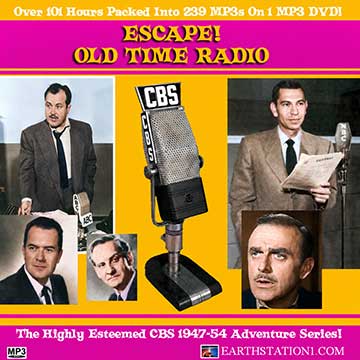
June 5, 1883: The History Of Rail
Transport: The History Of Rail Transportation In Europe: First
Regular Railroad Services: The Orient Express (The Express
d'Orient): -- The first regularly scheduled train service of the
Express d'Orient, renamed The Orient Express in 1891, departs from
Gare de l'Est railway station in Paris for Vienna via Munich.
Vienna remained the terminus until October 4, 1883, when the route
was extended to its first full run, departing from Gare de l'Est
railway station in Paris to Giurgiu in Romania via Munich and
Vienna. At Giurgiu, passengers were ferried across the Danube to
Ruse, Bulgaria, to pick up another train to Varna. They then
completed their journey to Constantinople by ferry. Prior to this,
the first Express d'Orient left Paris for Vienna on June 5, 1883,
with Vienna remaining the terminus of the run until the October 4,
1883 full run date. In 1885, another route began operations, this
time reaching Constantinople via rail from Vienna to Belgrade and
Nis, carriage to Plovdiv, and rail again to Istanbul. The two city
names most prominently associated with the Orient Express are
Paris and Constantinople (Istanbul), the original endpoints of the
timetabled service. On Sale @ 15% Off Discount Till Midnight PT!
https://store.earthstation1.com/escape-mp3-dvd-complete-radio-adventure-series-broadcast3.html
Today's
EarthStation1.com 15% Off Commemorative Memorial Title: The Boer
Wars: First Boer War & Second Boer War MP4 Video Download DVD
Today, June 5, 2026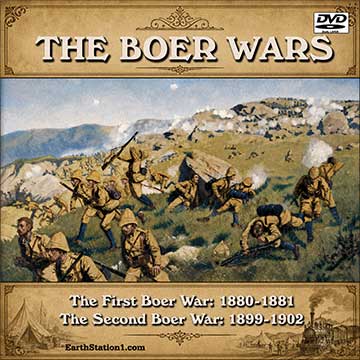
June 5, 1900: New Imperialism: The
Scramble For Africa: The Boer Wars: The Second Boer War (The Boer
War, The Anglo-Boer War, The South African War): The Second Phase
Of The Second Boer War: The British Offensive Of January-September
1900): -- British forces under the command of Field Marshal
Frederick Roberts take the Transvaal capital of Pretoria when Lt.
William Watson of the New South Wales Mounted Rifles, who
persuaded the Boers to surrender the capital, enters the city,
Before the war, the Boers had constructed several forts south of
Pretoria, but the artillery had been removed from the forts for
use in the field, and in the event they abandoned Pretoria without
a fight. Having won the principal cities, particularly
Johannesburg on May 31, Roberts declared the war over on September
3, 1900; and the South African Republic was formally annexed. On
Sale @ 15% Off Discount Till Midnight PT!
https://store.earthstation1.com/the-boer-wars-first-boer-war-amp-second-boer-war-mp4-video-download-dv4.html
Today's
EarthStation1.com 15% Off Commemorative Memorial Title: Fraulein
Doktor 1969 Suzy Kendall Kenneth More Nigel Green DVD MP4 USB
Today, June 5, 2026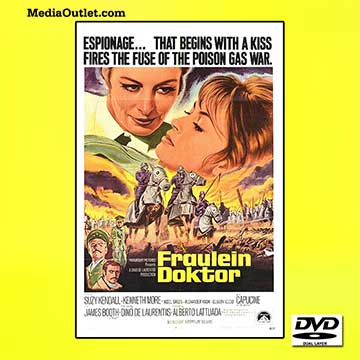
June 5, 1916: #DOTD: #RIP: Herbert
Kitchener, 1st Earl Kitchener, Irish-born British field marshal
and politician, Secretary Of State for War, Governor-General of
Sudan (b. June 24, 1850) #dies while sailing on the armoured
cruiser HMS Hampshire to Russia to attend negotiation when it
struck a German mine 1.5 miles (2.4 km) west of the Orkney
Islands, Scotland, and sank. Kitchener was among 737 who died.
Kitchener was seen standing on the quarterdeck during the
approximately twenty minutes that it took the ship to sink. His
body was never recovered. The news of Kitchener's death was
received with shock all over the British Empire. A man in
Yorkshire committed suicide at the news; a sergeant on the Western
Front was heard to exclaim "Now we've lost the war. Now we've
lost the war"; and a nurse wrote home to her family that she
knew Britain would win as long as Kitchener lived and now that he
was gone: "How awful it is - a far worse blow than many
German victories. So long as he was with us we knew even if things
were gloomy that his guiding hand was at the helm." The King
wrote in his diary: "It is indeed a heavy blow to me and a
great loss to the nation and the allies.". He ordered army
officers to wear black armbands for a week. Not everyone mourned
Kitchener's loss. C. P. Scott, editor of The Manchester Guardian,
is said to have remarked that "as for the old man, he could
not have done better than to have gone down, as he was a great
impediment lately." Field Marshal Horatio Herbert Kitchener,
1st Earl Kitchener, KG, KP, GCB, OM, GCSI, GCMG, GCIE, PC had won
notoriety for his imperial campaigns, most especially his scorched
earth policy against the Boers and his establishment of
concentration camps during the Second Boer War, and later played a
central role in the early part of the First World War. Kitchener
was credited in 1898 for winning the Battle of Omdurman that
helped him secure control of the Sudan for which he was made Lord
Kitchener of Khartoum, becoming a qualifying peer and of mid-rank
as an Earl. As Chief Of Staff (1900-02) in the Second Boer War he
played a key role in Lord Roberts' conquest of the Boer Republics,
then succeeded Roberts as commander-in-chief, by which time Boer
forces had taken to guerrilla fighting and British forces
imprisoned Boer civilians in concentration camps. His term as
Commander-in-Chief (1902-09) of the Army in India saw him quarrel
with another eminent proconsul, the Viceroy Lord Curzon, who
eventually resigned. Kitchener then returned to Egypt as British
Agent and Consul-General (de facto administrator). In 1914, at the
start of the First World War, Kitchener became Secretary Of State
for War, a Cabinet Minister. One of the few to foresee a long war,
lasting for at least three years, and with the authority to act
effectively on that perception, he organised the largest volunteer
army that Britain had seen, and oversaw a significant expansion of
materials production to fight on the Western Front. Despite having
warned of the difficulty of provisioning for a long war, he was
blamed for the shortage of shells in the spring of 1915 - one of
the events leading to the formation of a coalition government -
and stripped of his control over munitions and strategy.
Nevertheless, his commanding image, appearing on Alfred Leete's
"Lord Kitchener Wants You" recruiting posters, remains
recognised and parodied in popular culture, and was the
inspiration three year's later for James Montgomery Flagg's
recruitment poster depicting Uncle Sam in place of Kitchener with
the demand "I Want You For U.S. Army". On Sale @ 15% Off
Discount Till Midnight PT!
https://store.earthstation1.com/fraulein-doktor-1969-dvd-world-war-i-spy-thri1969.html
Today's
EarthStation1.com 15% Off Commemorative Memorial Title: Lawrence
Of Arabia aka T. E. Lawrence Documentaries DVD, Download, USB
Today, June 5, 2026
June 5, 1916: The European Civil War:
World War I: The First European War (The European Theater Of World
War I): The African Theatre Of World War I: The Middle Eastern
Theater Of World War I: The Arab Revolt (Arabic: Al-Thawra
Al-'Arabiyya) (The Great Arab Revolt [Arabic: Al-Thawra
al-'Arabiyya Al-Kubra]), The Sharifian Revolt): -- The Arab
rebellion against the Ottoman Empire breaks out when Faisal bin
Al-Hussein bin Ali Al-Hashemi and Abdullah bin Al-Hussein - the
sons of the Saudi Arabia leader the Hejaz (modern Western Saudi
Arabia), Hussein bin Ali al-Hashim, Sharif of Mecca - initiate
military operations at Medina in Hejaz, with the immediate aim of
securing independence from the ruling Ottoman Turks, and the long
term goal of creating a single unified Arab state stretching from
Aleppo in Syria to Aden in Yemen. On June 10, 1916 (9 Sha'ban of
the Islamic calendar for that year), Hussein bin Ali offficially
proclaimed the revolt at Mecca. Though the Sharifian revolt has
tended to be regarded as a revolt rooted in a secular Arab
nationalist sentiment, the Sharif did not present it in those
terms; rather, he accused the Young Turks of violating the sacred
tenets of Islam and called Arab Muslims to sacred rebellion
against the ostensibly "impious" Ottoman government.
Contrarily, Turks as well as many Arab leaders accused rebelling
tribes of betraying the Muslim Caliphate during a campaign against
imperialist powers which were trying to divide and govern the
Muslim lands. Ultimately, the revolt failed to generate
significant support from within the Ottoman Empire's Arab
provinces, and remained largely limited to tribal levies from the
Arabian Peninsula loyal to Sharif Hussein. On Sale @ 15% Off
Discount Till Midnight PT!
https://store.earthstation1.com/lawrence-of-arabia-dvd-t-e-lawrence-documentaries.html
Today's
EarthStation1.com 15% Off Commemorative Memorial Title: The Great
Depression 7 Part Documentary Series MP4 Video Download DVD
Today, June 5, 2026
June 5, 1916: First Jews: The United
States: The History Of The United States: The Supreme Court Of The
United States (SCOTUS): -- Louis Brandeis, American lawyer who
served as an associate justice on the Supreme Court of the United
States from 1916 to 1939, is sworn in as a Justice of the United
States Supreme Court; he is the first Jew to hold such a position.
Louis Brandeis was born Louis Dembitz Brandeis in Louisville,
Kentucky, the youngest of four children of immigrant parents from
Bohemia, who raised him in a Secular Jewish home. Starting in
1890, he helped develop the "right to privacy" concept
by writing a Harvard Law Review article of that title, and was
thereby credited by legal scholar Roscoe Pound as having
accomplished "nothing less than adding a chapter to our law."
He was a leading figure in the antitrust movement at the turn of
the century, particularly in his resistance to the monopolization
of the New England railroad and advice to Woodrow Wilson as a
candidate. In his books, articles and speeches, including Other
People's Money and How the Bankers Use It, and The Curse of
Bigness, he criticized the power of large banks, money trusts,
powerful corporations, monopolies, public corruption, and mass
consumerism, all of which he felt were detrimental to American
values and culture. He later became active in the Zionist
movement, seeing it as a solution to antisemitism in Europe and
Russia, while at the same time being a way to "revive the
Jewish spirit." When his family's finances became secure, he
began devoting most of his time to public causes and was later
dubbed the "People's Lawyer." He insisted on taking
cases without pay so that he would be free to address the wider
issues involved. The Economist magazine called him "A Robin
Hood of the law." Among his notable early cases were actions
fighting railroad monopolies, defending workplace and labor laws,
helping create the Federal Reserve System, and presenting ideas
for the new Federal Trade Commission. He achieved recognition by
submitting a case brief, later called the "Brandeis Brief",
which relied on expert testimony from people in other professions
to support his case, thereby setting a new precedent in evidence
presentation. Brandeis was a Republican before 1912, after then,
he switch to being a Democrat. In 1916, President Woodrow Wilson
nominated Brandeis to a seat on the Supreme Court of the United
States. His nomination was bitterly contested, partly because, as
Justice William O. Douglas later wrote, "Brandeis was a
militant crusader for social justice whoever his opponent might
be. He was dangerous not only because of his brilliance, his
arithmetic, his courage. He was dangerous because he was
incorruptible ... [and] the fears of the Establishment were
greater because Brandeis was the first Jew to be named to the
Court." On June 1, 1916, he was confirmed by the Senate by a
vote of 47 to 22, to become one of the most famous and influential
figures ever to serve on the high court. His opinions were,
according to legal scholars, some of the "greatest defenses"
of freedom of speech and the right to privacy ever written by a
member of the Supreme Court. Some have criticized Brandeis for
evading issues related to African Americans, as he did not author
a single opinion on any cases about race during his twenty-three
year tenure, and consistently voted with the court majority
including in support of racial segregation. Brandeis retired from
the Supreme Court on February 13, 1939, and he died in Washington,
D.C., aged 84. Both Brandeis and his wife are interred beneath the
portico of The Brandeis School Of Law of The University Of
Louisville, in Louisville, Kentucky. Brandeis himself made the
arrangements that made the law school one of only thirteen Supreme
Court repositories in the U.S. His professional papers are
archived at the library there. On Sale @ 15% Off Discount Till
Midnight PT! https://store.earthstation1.com/grde7padosem.html
Today's
EarthStation1.com 15% Off Commemorative Memorial Title: World War
1 TV Series With Robert Ryan DVD, Video Download, USB Drive
Today, June 5, 2026
June 5, 1917: The European Civil War:
World War I: The First European War (The European Theater Of World
War I): The Western Front Of World War I: The United States In
World War I: The Selective Service Act Of 1917: Army Registration
Day: -- Conscription begins in the United States, pursuant to the
May 18, 1917 enactment of The Selective Service Act Of 1917, which
authorized the United States federal government to raise a
national army for service in World War I. It was envisioned in
December 1916 and brought to President Woodrow Wilson's attention
shortly after the break in relations with Germany in February
1917. The Act itself was drafted by then-Captain (later Brigadier
General) Hugh S. Johnson after the United States entered World War
I by declaring war on Germany. The Act was canceled with the end
of the war on November 11, 1918. The Act was upheld as
constitutional by the United States Supreme Court in 1918. On Sale
@ 15% Off Discount Till Midnight PT!
https://store.earthstation1.com/world-war-1-robert-ryan-4-dual-layer-dvds-26-episode-tv-se1426.html
Today's
EarthStation1.com 15% Off Commemorative Memorial Title: Franklin
D. Roosevelt Documentaries DVD, Video Download, USB Drive
Today, June 5, 2026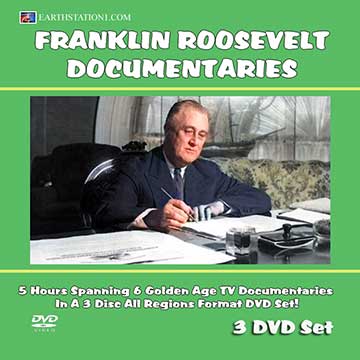
June 5, 1933: April 5, 1933: The Interwar
Period (The Interbellum, Between The Wars): The Great Depression:
The Great Depression In The United States: The Trading With The
Enemy Act (TWEA): The New Deal: The First New Deal: The Emergency
Banking Act (EBA, The Emergency Banking Relief Act): The Gold
Repeal Joint Resolution: -- The U.S. Congress abrogates the United
States' use of the gold standard by enacting a joint resolution
(48 Stat. 112, H.J.Res. 192) nullifying the right of creditors to
demand payment in gold, "To assure uniform value to the coins
and currencies of the United States." It was a follow-up of
Executive Order 6102, an executive order signed on April 5, 1933,
by US President Franklin D. Roosevelt "forbidding the
hoarding of gold coin, gold bullion, and gold certificates within
the continental United States." The executive order was made
under the authority of the Trading with the Enemy Act of 1917, as
amended by the Emergency Banking Act in March 1933." On Sale
@ 15% Off Discount Till Midnight PT!
https://store.earthstation1.com/franklin-roosevelt-documentaries-dual-layer-dvd.html
Today's
EarthStation1.com 15% Off Commemorative Memorial Title: Seven Days
In The Life Of The President LBJ 1965 DVD MP4 USB Drive
Today, June 5, 2026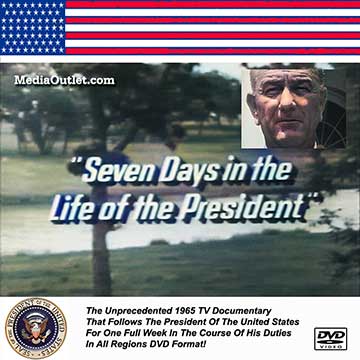
June 5, 1934: #BOTD: #HBD! Bill Moyers,
American journalist and network television news and political
commentator, 13th White House Press Secretary serving in the
Johnson administration from 1965 to 1967 is #born Billy Don Moyers
in Hugo in Choctaw County in southeastern Oklahoma, the son of
John Henry Moyers, a laborer, and Ruby Johnson Moyers. Moyers was
reared in Marshall, Texas. Moyers has been extensively involved
with public broadcasting, producing documentaries and news journal
programs. He has won numerous awards and honorary degrees for his
investigative journalism and civic activities. He has become
well-known as a trenchant critic of the corporately structured
U.S. news media. Bill Moyers died from complications relating to
prostate cancer at Memorial Sloan Kettering Cancer Center in
Manhattan, New York City, aged 91. He is buried at Algoma Cemetery
South and North in his hometown of Algoma Cemetery South and North
in Marshall, Texas. On Sale @ 15% Off Discount Till Midnight PT!
https://store.earthstation1.com/seven-days-in-the-life-of-the-president-dvd-lyndon-johnson-1965.html
Today's
EarthStation1.com 15% Off Commemorative Memorial Title: Victory In
The West (Sieg Im Westen) 1941 WWII Film DVD, MP4, USB
Today, June 5, 2026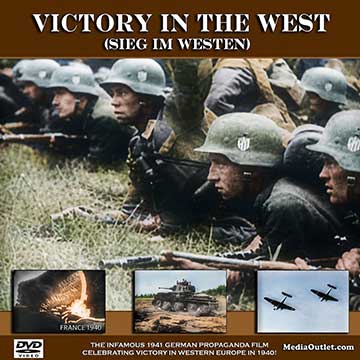
June 5, 1940: The European Civil War:
World War II: The Second European War (The European Theater Of
World War II): The Battle Of France (The Western Campaign [German:
Westfeldzug], The French Campaign [German: Frankreichfeldzug;
French: Campagne De France], The Fall Of France): Fall Rot
(German: "Case Red"): -- After a brief lull in the
Battle Of France, the Germans renew the offensive against the
remaining French divisions south of the River Somme in Operation
Fall Rot ("Case Red"), the plan for the second phase of
the conquest of France. It had been made possible by the success
of Fall Gelb (Case Yellow), the invasion of the Benelux countries
and northern France in the Battle Of France and the encirclement
of the Allied armies in the north on the Channel coast. Powerful
forces were also to advance into France. Fall Rot consisted of two
sub-operations: 1) the preliminary attack in the west that began
on June 5 over the river Somme in the direction of the Seine, and
2) the main offensive by Army Group A started on June 9 in the
centre over the river Aisne. On Sale @ 15% Off Discount Till
Midnight PT!
https://store.earthstation1.com/victory-in-the-west-dvd-sieg-im-westen-german-wwii-propaganda.html
Today's
EarthStation1.com 15% Off Commemorative Memorial Title: The Call
To Glory: Chennault And The Flying Tigers DVD, Download, USB
Today, June 5, 2026
June 5, 1941: China: The History Of
China: The Century Of Humiliation (The Hundred Years Of National
Humiliation): The Sino-Japanese Wars: World War II: Air Warfare Of
World War II: The Asia-Pacific War: The Second Sino-Japanese War:
(The War Of Resistance Against Japanese Aggression): Air Warfare
Of The Second Sino-Japanese War: The Bombing Of Chongqing
(Chinese: Chongqing Da Hongzha; Japanese: Jukeibakugeki) (The
Bombing Of Chungking): -- Four thousand Chongqing residents are
asphyxiated in a bomb shelter during the Bombing Of Chongqing,
also called the Bombing Of Chungking, part of a terror bombing
operation conducted by the Imperial Japanese Army Air Service and
Imperial Japanese Navy Air Service on the Chinese provisional
capital of Chongqing, authorized by the Japanese Imperial General
Headquarters. A total of 268 air raids were conducted against
Chongqing, with more than 11,500, mainly incendiary, bombs
dropped. The targets were usually residential areas, business
areas, schools, hospitals and other non-military targets. These
bombings were probably aimed at cowing the Chinese government, or
as part of the planned Sichuan invasion. On Sale @ 15% Off
Discount Till Midnight PT!
https://store.earthstation1.com/the-call-to-glory-chennault-and-the-flying-tigers-dvd-wwii.html
Today's
EarthStation1.com 15% Off Commemorative Memorial Title: Turning
Points Of Second World War Midway El Alamein Stalingrad DVD MP4
USB
Today, June 5, 2026
(#JCKaelin here: This is a day for me, my
fellow citizens of Bayonne, and all of us to bow our heads in
remembrance of a man born and raised in Bayonne, whose stomping
grounds include the same avenues and boulevards we all here travel
on - the man whose single day of combat changed the entire course
of World War II! ========= June 4-7, 1942: World War II: The
Pacific War (The Asia-Pacific War, The Pacific Theater Of World
War II): The Pacific Ocean Theater Of World War II: The Battle Of
Midway: -- June 5: -- The Battle Of Midway continues, the turning
point of The Pacific War and in the eyes of many of all World War
II, as two Japanese aircraft carriers are sunk: the Akagi at 0500,
and the Hiryu at 0900. It is certain that Bayonne-born Richard
Halsey Best was wholly responsible for the sinking of the Akagi,
and he may well have been singly responsible for sinking the
Hiryu, which means he may have been the first pilot to
successfully bomb two Japanese carriers in one day. The Battle of
Midway was a decisive naval battle in the Pacific Theater of World
War II which occurred on June 4-7, 1942, only six months after
Japan's attack on Pearl Harbor and one month after the historic
Battle Of The Coral Sea. The United States Navy under Admirals
Chester Nimitz, Frank Jack Fletcher, and Raymond A. Spruance
defeated an attacking fleet of the Imperial Japanese Navy under
Admirals Isoroku Yamamoto, Chuichi Nagumo, and Nobutake Kondo near
Midway Atoll, inflicting devastating damage on the Japanese fleet
that proved irreparable. Military historian John Keegan called it
"the most stunning and decisive blow in the history of naval
warfare.". The Japanese operation, like the earlier attack on
Pearl Harbor, sought to eliminate the United States as a strategic
power in the Pacific, thereby giving Japan a free hand in
establishing its Greater East Asia Co-Prosperity Sphere. The
Japanese hoped another demoralizing defeat would force the U.S. to
capitulate in the Pacific War and thus ensure Japanese dominance
in the Pacific. Luring the American aircraft carriers into a trap
and occupying Midway was part of an overall "barrier"
strategy to extend Japan's defensive perimeter, in response to the
Doolittle air raid on Tokyo. This operation was also considered
preparatory for further attacks against Fiji, Samoa, and Hawaii
itself. The plan was handicapped by faulty Japanese assumptions of
the American reaction and poor initial dispositions. Most
significantly, American cryptographers at Station HYPO in Hawaii
were able to determine from decryptions of the Japanese JN-25
naval communications cypher the date and location of the planned
attack, enabling the forewarned U.S. Navy to prepare its own
ambush. There were seven aircraft carriers involved in the battle,
and all four of Japan's large fleet carriers - Akagi, Kaga, Soryu
and Hiryu, part of the six-carrier force that had attacked Pearl
Harbor six months earlier - and the heavy cruiser Mikuma were
sunk, while the U.S. lost only the carrier USS Yorktown and the
destroyer USS Hammann. After Midway and the exhausting attrition
of the Solomon Islands campaign, Japan's capacity to replace its
losses in materiel (particularly aircraft carriers) and men
(especially well-trained pilots and maintenance crewmen) rapidly
became insufficient to cope with mounting casualties, while the
United States' massive industrial and training capabilities made
losses far easier to replace. The Battle of Midway, along with the
Guadalcanal Campaign, is widely considered the turning point in
the Pacific War. On Sale @ 15% Off Discount Till Midnight PT!
https://store.earthstation1.com/turning-points-of-2nd-world-war-midway-el-alamein-stalingrad-dv2.html
Today's
EarthStation1.com 15% Off Commemorative Memorial Title: Ike: The
War Years Complete 2 Part TV Miniseries DVD, MP4, USB Drive
Today, June 5, 2026
June 5, 1944: The European Civil War:
World War II: The Second European War (The European Theater Of
World War II): The Western Front Of World War II: Operation
Overlord (The Battle Of Normandy): D-Day (The D-Day Landings, The
Normandy Landings): Weather Forecasting For Operation Overlord: --
At four in the morning, the final go/no go conference for the
operational commencement of The Normandy Landings was held. RAF
Group Captain James Stagg, Chief Meteorological Officer, told them
"Some good news. Gentleman, no substantial change has taken
place since last time, but as I see it, the little has changed is
in the direction of optimism... as the predicted good weather
should last until tomorrow, with good visibility and winds not
more than Force 4." (sic). Eisenhower was surprised; he wrote
of "wind of almost hurricane proportions shaking and
shuddering his Sharpener camp (and) it seemed impossible that in
such conditions there was any reason for even discussing the
situation." Eisenhower's three commanders - Admiral Sir
Bertram Ramsay, Air Marshal Sir Trafford Leigh-Mallory and General
Bernard Montgomery - all advised "Go"; Ramsay noted of
the meteorologists that 'this time the prophets came in smiling".
Montgomery and Major General Walter Bedell Smith, Eisenhower's
chief of staff, were eager to launch the invasion. Admiral Bertram
Ramsay was prepared to commit his ships, while Air Chief Marshal
Trafford Leigh-Mallory expressed concern that the conditions would
be unfavourable for Allied aircraft. There are conflicting reports
of what happened next; after much discussion, after either
considering in silence for some minutes, or mere moments according
to Eisenhower, at 4:15 am Eisenhower said either "OK, we'll
go" or "OK, let's roll". The room then filled with
cheering, Stagg thought of them that they "look like new men.
It was a marvel to behold." After a few questions to Stagg,
they dispersed, and Stagg headed for his tent in the Southwick
House grounds to get some sleep. D-Day, the largest amphibious
landing in history, began in the early-morning hours of June 6,
1944 as Allied forces landed in Normandy on the north coast of
France. Operation Overlord took months of planning and involved
1,527,000 soldiers in 47 Allied divisions along with 4,400 ships
and landing craft, and 11,000 aircraft. The Germans had about 60
divisions spread along France and the low countries. American
forces landed on two western beaches, Utah and Omaha, while
British and Canadian troops landed farther east on Gold, Juno and
Sword beaches. By the end of the day 150,000 Allied soldiers and
their accompanying vehicles had landed with 15,000 killed and
wounded. On Sale @ 15% Off Discount Till Midnight PT!
https://store.earthstation1.com/ike-the-war-years-complete-tv-miniseries-dual-layer-dvd.html
Today's
EarthStation1.com 15% Off Commemorative Memorial Title: D-Day:
Assault On Fortress Europe The War Files DVD, MP4, USB Drive
Today, June 5, 2026
June 5, 1944: The European Civil War:
World War II: The Second European War (The European Theater Of
World War II): The Western Front Of World War II: Operation
Overlord (The Battle Of Normandy): D-Day (The D-Day Landings, The
Normandy Landings): Fortress Europe (German: Festung Europa): The
Atlantic Wall (German: Atlantikwall): -- More than 1000 British
bombers drop 5,000 tons of bombs on German gun batteries on the
Normandy coast of The Atlantic Wall of Fortress Europe in
preparation for the next day's Normandy Landings. The allies made
it a point, as part of their deception campaign as to where they
would land their liberation forces, to aerially bombard targets
other than Normandy ten times more than Normandy itself to
distract attention from it as a landing site. As June 5 was the
day immediately before the landings, it was imperative to ensure
it was bombed sufficiently to allow a successful invasion force
landing. The Atlantic Wall (German: Atlantikwall) was an extensive
system of coastal defences and fortifications built by Nazi
Germany between 1942 and 1944 along the coast of continental
Europe and Scandinavia as a defence against an anticipated Allied
invasion of Nazi-occupied Europe from the United Kingdom, during
World War II. The manning and operation of the Atlantic Wall was
administratively overseen by the German Army, with some support
from Luftwaffe ground forces. Fortress Europe (German: Festung
Europa) was a military propaganda term used by both sides of the
Second World War which referred to the areas of Continental Europe
occupied by Nazi Germany, as opposed to the United Kingdom across
the Channel. On Sale @ 15% Off Discount Till Midnight PT!
https://store.earthstation1.com/dday-assault-on-fortress-europe--the-war-files-dvd.html
Today's
EarthStation1.com 15% Off Commemorative Memorial Title: The Battle
Of Berlin, The Battle For Berlin DVD MP4 Download USB Drive
Today, June 5, 2026
June 5, 1945: The Aftermath Of World War
II: The Allied Occupation Of Germany: The Allied Control Council
(ACC) (Allied Control Authority [German: Alliierter Kontrollrat]),
The Four Powers [German: Vier Machte], The Four-Power
Authorities): -- The Allied Control Council (ACC), the military
occupation governing body of Germany, formally takes power, with
its headquarters at Kammergericht building in Berlin. The Allied
Control Council was the governing body of the Allied occupation
zones in Germany (1945-1949/1991) and Austria (1945-1955) after
the end of World War II in Europe. After the defeat of the Nazis,
Germany (less its former eastern territories) and Austria were
occupied as two different areas, both by the same four Allies.
Both were later divided into four zones by the 1 August 1945
Potsdam Agreement. Its members (Four-Power Authorities) were the
Soviet Union, the United Kingdom, the United States, and France.
The organisation was based in Schoneberg, Berlin. The council was
convened to determine several plans for postwar Europe, including
how to change borders and transfer populations in Central Europe.
As the four powers had joined themselves into a condominium
asserting supreme power in Germany, the Allied Control Council was
constituted the sole legal sovereign authority for Germany as a
whole, replacing the civil government of Germany under the Nazi
Party. In 1948, the Soviets withdrew from the ACC due to its
conflict with the western Allies, who then established the Allied
High Commission. In 1949, two German states (West and East
Germany) were founded and, along with the state of Austria, were
granted sovereignty in 1955. On Sale @ 15% Off Discount Till
Midnight PT!
https://store.earthstation1.com/timewatch-the-battle-for-berlin-dvd.html
Today's
EarthStation1.com 15% Off Commemorative Memorial Title: Eyes On
The Prize II: America At The Racial Crossroads DVD MP4 USB
Today, June 5, 2026
June 5, 1945: #BOTD: #HBD! John Carlos,
African American track and field athlete and professional football
player, is #born John Wesley Carlos in Harlem, New York. He was
the bronze-medal winner in the 200 meters at the 1968 Summer
Olympics, where he participated in the 1968 Olympics Black Power
Salute with gold medalist Tommie Smith. During their 1968 Summer
Olympics medal ceremony in the Olympic Stadium in Mexico City on
October 16, 1968, two African American athletes, Tommie Smith and
John Carlos, each raised a black-gloved fist during the playing of
the US national anthem, "The Star-Spangled Banner".
While on the podium, Smith and Carlos, who had won gold and bronze
medals respectively in the 200-meter running event of the 1968
Summer Olympics, turned to face the US flag and then kept their
hands raised until the anthem had finished. In addition, Smith,
Carlos, and Australian silver medalist Peter Norman all wore
human-rights badges on their jackets. Carlos and Smith made
headlines around the world by black-gloved fist raising. Both
athletes wore black socks and no shoes on the podium to represent
African American poverty in the United States. In support, Peter
Norman, the silver medalist who was a white athlete from
Australia, participated in the protest by wearing an Olympic
Project for Human Rights (OPHR) badge. International Olympic
Committee (IOC) president Avery Brundage deemed it to be a
domestic political statement unfit for the supposedly apolitical,
international forum the Olympic Games were claimed to be. In
response to their actions, he ordered Smith and Carlos suspended
from the US team and banned from the Olympic Village. When the US
Olympic Committee refused, Brundage threatened to ban the entire
US track team. This threat led to the expulsion of the two
athletes from the Games. A spokesman for the IOC said Smith and
Carlos's actions were "a deliberate and violent breach of the
fundamental principles of the Olympic spirit." (Brundage, who
was president of the United States Olympic Committee in 1936, had
made no objections against Nazi salutes during the Berlin
Olympics. He argued that the Nazi salute, being a national salute
at the time, was acceptable in a competition of nations, while the
athletes' salute was not of a nation and therefore unacceptable.
The 1972 Summer Olympics at Munich, West Germany were Avery
Brundage's final Games as president of the IOC. The event was
marred by tragedy and controversy when eleven Israeli team members
were murdered by Palestinian terrorists. At the memorial service,
Brundage decried the politicization of sports and refused to
cancel the remainder of the Olympics, declaring "the Games
must go on." Although those in attendance applauded
Brundage's statement, his decision to continue the Games has since
been harshly criticized, and his actions in 1936 and 1972 seen as
evidence of anti-Semitism. In retirement, Brundage married his
second wife, a German princess.) John Carlos went on to tie the
world record in the 100-yard dash and beat the 200 meters world
record (although the latter achievement was never certified).
After his track career, he enjoyed a brief stint in the Canadian
Football League but retired due to injury. He became involved with
the United States Olympic Committee and helped to organize the
1984 Summer Olympics. Following this, he became a track coach at
Palm Springs High School. He was inducted into the USA Track &
Field Hall of Fame in 2003. He is the author, with sportswriter
Dave Zirin, of The John Carlos Story: The Sports Moment That
Changed the World, published in 2011 by Haymarket Books. On Sale @
15% Off Discount Till Midnight PT!
https://store.earthstation1.com/eyes-on-the-prize-ii-dvd-set-4-discs-complete-2nd-seri42.html
Today's
EarthStation1.com 15% Off Commemorative Memorial Title: After The
War: The Marshall Plan + Bonus DVD MP4 Download USB Drive
Today, June 5, 2026
June 5, 1947: The Aftermath Of World War
II: The Cold War: The Cold War (1947-1953): The Marshall Plan (The
European Recovery Program): The June 5, 1947 Marshall Plan Speech
At Harvard University: -- In a speech at Harvard University, the
United States Secretary Of State George Marshall calls for
economic aid to war-torn Europe. The Marshall Plan (officially the
European Recovery Program, ERP) was an American initiative to aid
Western Europe, in which the United States gave over 13B USD
(nearly 110B USD in 2016) in economic assistance to help rebuild
Western European economies after the end of World War II. The plan
was in operation for four years beginning on April 3, 1948. The
goals of the United States were to rebuild war-torn regions,
remove trade barriers, modernize industry, improve European
prosperity, and prevent the spread of Communism. The Marshall Plan
required a lessening of interstate barriers, a dropping of many
regulations, and encouraged an increase in productivity, trade
union membership, as well as the adoption of modern business
procedures. The Marshall Plan aid was divided amongst the
participant states roughly on a per capita basis. A larger amount
was given to the major industrial powers, as the prevailing
opinion was that their resuscitation was essential for general
European revival. Somewhat more aid per capita was also directed
towards the Allied nations, with less for those that had been part
of the Axis or remained neutral. The largest recipient of Marshall
Plan money was the United Kingdom (receiving about 26% of the
total), followed by France (18%) and West Germany (11%). Some
eighteen European countries received Plan benefits. Although
offered participation, the Soviet Union refused Plan benefits, and
also blocked benefits to Eastern Bloc countries, such as Hungary
and Poland. The United States provided similar aid programs in
Asia, but they were not part of the Marshall Plan. However, its
role in the rapid recovery has been debated. Most reject the idea
that it alone miraculously revived Europe, since the evidence
shows that a general recovery was already under way. The Marshall
Plan's accounting reflects that aid accounted for less than 3% of
the combined national income of the recipient countries between
1948 and 1951, which means an increase in GDP growth of only 0.3%.
After World War II, in 1947, industrialist Lewis H. Brown wrote at
the request of General Lucius D. Clay, A Report on Germany, which
served as a detailed recommendation for the reconstruction of
post-war Germany, and served as a basis for the Marshall Plan. The
initiative was named after United States Secretary Of State George
Marshall. The plan had bipartisan support in Washington, where the
Republicans controlled Congress and the Democrats controlled the
White House with Harry S. Truman as President. The Plan was
largely the creation of State Department officials, especially
William L. Clayton and George F. Kennan, with help from the
Brookings Institution, as requested by Senator Arthur H.
Vandenberg, chairman of the Senate Foreign Relations Committee.
Marshall spoke of an urgent need to help the European recovery in
his address at Harvard University in June 1947. The purpose of the
Marshall Plan was to aid in the economic recovery of nations after
WWII and to reduce the influence of Communist parties within them.
To combat the effects of the Marshall Plan, the USSR developed its
own economic plan, known as the Molotov Plan, in spite of the fact
that large amounts of resources from the Eastern Bloc countries to
the USSR were paid as reparations, for countries participating in
the Axis Power during the war. The phrase "equivalent of the
Marshall Plan" is often used to describe a proposed
large-scale economic rescue program. On Sale @ 15% Off Discount
Till Midnight PT!
https://store.earthstation1.com/after-the-war-the-marshall-plan-dvd.html
Today's
EarthStation1.com 15% Off Commemorative Memorial Title: United
Nations Documentaries Set DVD MP4 Download USB Drive
Today, June 5, 2026
June 5, 1947: #BOTD: #HBD! Laurie
Anderson, American avant-garde artist, singer-songwriter,
composer, violinist and film director and is #born Laura Phillips
Anderson in Glen Ellyn, Illinois. Her work spans performance art,
pop music, and multimedia projects. Initially trained in violin
and sculpting, Anderson pursued a variety of performance art
projects in New York during the 1970s, focusing particularly on
language, technology, and visual imagery. She became more widely
known outside the art world when her single "O Superman"
reached number two on the UK singles chart in 1981. She also
starred in and directed the 1986 concert film Home of the Brave.
Anderson is a pioneer in electronic music and has invented several
devices that she has used in her recordings and performance art
shows. In 1977, she created a tape-bow violin that uses recorded
magnetic tape on the bow instead of horsehair and a magnetic tape
head in the bridge. In the late 1990s, she collaborated with
Interval Research to develop an instrument she called a "talking
stick", a six-foot (1.8 m) long baton-like MIDI controller
that can access and replicate sounds. Anderson met
singer-songwriter Lou Reed in 1992, and was married to him from
2008 until his death in 2013. On Sale @ 15% Off Discount Till
Midnight PT!
https://store.earthstation1.com/united-nations-documentaries-set-dvd-mp4-download-usb-driv4.html
Today's
EarthStation1.com 15% Off Commemorative Memorial Title: King: A
Filmed Record: Montgomery To Memphis DVD, Download, USB Drive
Today, June 5, 2026
June 5, 1956: Civil Rights Movements: The
American Civil Rights Movement (1954-1968): Anti-Black Racism In
The United States: Segregation: Racial Segregation: Civil Rights
Protests: Civil Rights Protests In The United States: Transport
And Bus Segregation In The United States: Transport And Bus
Boycotts In The United States: The Montgomery Bus Boycott: -- The
United States District Court for the Middle District of Alabama
rules 2-1 in the Browder v. Gayle case that Montgomery and Alabama
state bus segregation laws were unconstitutional under the Equal
Protection Clause of the 14th Amendment to the U.S. Constitution,
an amendment that addresses citizenship rights and equal
protection under the law. The state and city appealed, and the
decision was summarily affirmed by the United States Supreme Court
on November 13, 1956. The Montgomery Bus Boycott began in
Montgomeray, Alabama on December 5, 1955 in response to the arrest
of Rosa Parks for refusing to give up her seat on a municipal bus
to a white man. Organized by the African American community, the
boycott lasted until December 20, 1956, when a U.S. Supreme Court
ruling integrated the public transportation system. On December 1,
1955, Rosa Parks was arrested in Montgomery, Alabama, for refusing
to obey municipal bus driver James F. Blake' order to give up her
seat in the "colored section" to a white passenger,
after the whites-only section was filled, and then to move to the
back section of a bus. NAACP organizers believed that Parks was
the best candidate for seeing through a court challenge as a
result of her arrest for civil disobedience in violating Alabama
segregation laws. Others had taken similar steps, including Bayard
Rustin in 1942, Irene Morgan in 1946, Lillie Mae Bradford in 1951,
Sarah Louise Keys in 1952, and the members of the ultimately
successful Browder v. Gayle 1956 lawsuit (Claudette Colvin,
Aurelia Browder, Susie McDonald, and Mary Louise Smith) who were
arrested in Montgomery for not giving up their bus seats months
before Parks. Parks' act of defiance and the Montgomery bus
boycott became important symbols of the modern Civil Rights
Movement. On November 13, 1956, the U.S. Supreme Court ruled in
the case of Browder v. Gayle that racial segregation on public
buses was unconstitutional and declares Alabama laws requiring
segregated buses illegal, thus ending the Montgomery Bus Boycott.
On Sale @ 15% Off Discount Till Midnight PT!
https://store.earthstation1.com/king-a-filmed-record--montgomery-to-memphis-dvd.html
Today's
EarthStation1.com 15% Off Commemorative Memorial Title: Elvis
Presley Documentaries Set MP4 Video Download DVD
Today, June 5, 2026
June 5, 1956: Aesthetics: Performing
Arts: Premieres: Television Premieres: United States Television
Premieres: -- Elvis Presley introduces his new single, "Hound
Dog", on The Milton Berle Show, scandalizing the audience
with his suggestive hip movements. It was his second appearance on
Berle's program, and his eighth appearance on national television
since his debut on January 28, 1956, on Tommy and Jimmy Dorsey's
Stage Show, which was then recorded and broadcast from the CBS-TV
studio in New York City. For the first time Presley appeared on
national television sans guitar. Berle later told an interviewer
that he had told Elvis to leave his guitar backstage. "Let
'em see you, son", advised Uncle Miltie. By this time, Scotty
Moore had added a guitar solo to the song, and D.J. Fontana had
added a hot drum roll between verses of the song. However, in
performing "Hound Dog" "Elvis sings the first line
like Freddie Bell and the Bellboys, who repeat "hound dog"
behind the lead singer: Elvis sings "hound dog" and his
"second voice" repeats "hound dog." By the
third verse, he sings the phrase like Thornton." An upbeat
version ended abruptly as Presley threw his arm back, then began
to vamp at half tempo, "You ain't-a nuthin' but a hound dog,
cuh-crying all the time. You ain't never caught a rabbit _" A
final wave signaled the band to stop. Elvis pointed threateningly
at the audience, and belted out, "You ain't no friend of
mine.". Presley's movements during the performance were
energetic and exaggerated and the reactions of young women in the
studio audience were enthusiastic, as shown on the broadcast. Over
40,000,000 people saw the performance, and the next day,
controversy exploded. According to Robert Fink, while "Hound
Dog" as performed by Presley was intended as a "witty
multiracial piece of sygnifyin' humor, troping off white
overreactions to a black sexual innuendo ... nobody got the joke
... The display was not taken as parody. 'Hound Dog' confirmed
mainstream America's worst fears about rock and roll, and sparked
nationwide vituperation; for the first time, Presley ... was
attacked in the media as a sexual exhibitionist with no musical
talent.". This performance of "Hound Dog" "triggers
the first controversy of his career. Presley sings his latest
single, "Hound Dog," with all the pelvis-shaking
intensity his fans scream for. Television critics across the
country slam the performance for its "appalling lack of
musicality," for its "vulgarity" and "animalism."
The Catholic Church took up the criticism in its weekly organ in a
piece headlined "Beware Elvis Presley.". Concerns about
juvenile delinquency and the changing moral values of the young
found a new target in the popular singer. After Berle's show, Ed
Sullivan, whose variety show is one of television's most popular,
declared that he would never hire Presley. Steve Allen, who had
already booked Presley for The Tonight Show, resisted pressure
from NBC to cancel the performance, promising he would not allow
the singer to offend. Cultural theorist David Shumway wrote,
"Berle's network, NBC, received letters of protest, and the
various self-appointed guardians of public morality attacked Elvis
in the press.". TV critics began a merciless campaign against
Elvis, making statements that he had a "caterwauling voice
and nonsense lyrics" and was an "influence on juvenile
delinquency" (despite the fact that when he started the
movements, most of the audience laughed at it), and began using
the sobriquet "Elvis the Pelvis". "Hound Dog"
is a twelve-bar blues song written by the American songwriting and
record producing partners Jerry Leiber and Mike Stoller. Recorded
originally by Willie Mae "Big Mama" Thornton on August
13, 1952, in Los Angeles and released by Peacock Records in late
February 1953, "Hound Dog" was Thornton's only hit
record, selling over 500,000 copies, spending 14 weeks in the R
and B charts, including seven weeks at number one. Thornton's
recording of "Hound Dog" is listed as one of the Rock
and Roll Hall of Fame's "500 Songs That Shaped Rock and
Roll", and was inducted into the Grammy Hall of Fame in
February 2013. "Hound Dog" has been recorded more than
250 times. The best-known version is the July 1956 recording by
Elvis Presley, which is ranked number 19 on Rolling Stone
magazine's list of the 500 Greatest Songs of All Time; it is also
one of the best-selling singles of all time. Presley's version,
which sold about 10 million copies globally, was his best-selling
song and "an emblem of the rock 'n' roll revolution". It
was simultaneously number one on the US pop, country, and R and B
charts in 1956, and it topped the pop charts for 11 weeks - a
record that stood for 36 years. Presley's 1956 RCA recording was
inducted into the Grammy Hall of Fame in 1988, and it is listed as
one of the Rock and Roll Hall of Fame's "500 Songs That
Shaped Rock and Roll". "Hound Dog" has been at the
center of controversies and several lawsuits, including disputes
over authorship, royalties, and copyright infringement by the many
answer songs released by such artists as Rufus Thomas and Roy
Brown. From the 1970s onward, the song has been featured in
numerous films, including Grease, Forrest Gump, Lilo and Stitch, A
Few Good Men, Hounddog, Indiana Jones and the Kingdom of the
Crystal Skull, and Nowhere Boy. On Sale @ 15% Off Discount Till
Midnight PT!
https://store.earthstation1.com/viva-elvis-dvd-elvis-presley-cult-documentary.html
Today's
EarthStation1.com 15% Off Commemorative Memorial Title: An Ocean
Apart: US-UK Relations TV Series + Profumo Affair MP4 DVD Set
Today, June 5, 2026
June 5, 1963: Scandals: Political
Scandals: Political Scandals Of The United Kingdom: Sex Scandals:
Espionage Scandals And Incidents: The Profumo Affair: -- The
British Secretary Of State for War, John Profumo, resigns in a sex
scandal known as the "Profumo Affair", a British
political scandal that originated with a brief sexual relationship
in 1961 between John Profumo, the Secretary Of State for War in
Harold Macmillan's Conservative government, and Christine Keeler,
a 19-year-old would-be model. In March 1963, Profumo's denial of
any impropriety, in a personal statement to the House Of Commons,
was refuted a few weeks later with his admission of the truth. He
resigned from the government and from Parliament. The
repercussions of the affair severely damaged Macmillan's
self-confidence, and he resigned as Prime Minister on health
grounds in October 1963. His Conservative Party was marked by the
scandal, which may have contributed to its defeat by the Labour
Party in the 1964 general election. When the Profumo-Keeler affair
was first revealed, public interest was heightened by reports that
Keeler may have been simultaneously involved with Captain Yevgeny
Ivanov, a Soviet naval attache, thereby creating a possible
security risk. Keeler knew both Profumo and Ivanov through her
friendship with Stephen Ward, an osteopath and socialite who had
taken her under his wing. The exposure of the affair generated
rumours of other scandals, and drew official attention to the
activities of Ward, who was charged with a series of immorality
offences. Perceiving himself as a scapegoat for the misdeeds of
others, Ward took a fatal overdose during the final stages of his
trial, which found him guilty of living off the immoral earnings
of Keeler and her friend Mandy Rice-Davies. An inquiry into the
affair by a senior judge, Lord Denning, indicated that there had
been no breaches of security arising from the Ivanov connection,
although Denning's report was later condemned as superficial and
unsatisfactory. Profumo subsequently sought private atonement as a
volunteer worker at Toynbee Hall, an East London charitable trust.
He died in 2006. Keeler found it difficult to escape the negative
image attached to her by press, law and parliament throughout the
Profumo affair. In various, sometimes contradictory accounts, she
has challenged Denning's conclusions relating to security issues.
Ward's conviction has been described by analysts as an act of
Establishment revenge, rather than serving justice. In January
2014 his case was under review by the Criminal Cases Review
Commission, with the possibility of a later reference to the Court
of Appeal. Dramatisations of the Profumo affair have been shown on
stage and screen. The influential British satirical television
programme, That Was The Week That Was, also known as TW3, a
satirical television comedy programme on BBC Television in 1962
and 1963 that was devised, produced and directed by Ned Sherrin
and presented by David Frost that is considered a significant
element of the satire boom in the UK in the early 1960s and broke
ground in comedy through lampooning the establishment and
political figures, coincided with coverage of the politically
charged Profumo affair and John Profumo, the politician at the
centre of the affair, lending much to the show's popularity and
its effects on British culture. On Sale @ 15% Off Discount Till
Midnight PT!
https://store.earthstation1.com/an-ocean-apart-us-uk-relations-tv-series-profumo-affair-mp4-dvd-set.html
Today's
EarthStation1.com 15% Off Commemorative Memorial Title: The
Six-Day War: The 1967 Arab-Israeli War MP4 Video Download DVD
Today, June 5, 2026
June 5, 1967: The Cold War: The Arab Cold
War (July 23, 1952 - February 11, 1979): The Arab-Israeli
Conflict: The Israeli-Palestinian Conflict: The Six-Day War
((Hebrew: Milhemet Seset HaYamim; Arabic: An-Naksah, "The
Setback", Harb 1967, "The War Of 1967") (The June
War, The 1967 Arab-Israeli War, The Third Arab-Israeli War): --
Israel launches surprise strikes against Egyptian air-fields in
response to the mobilisation of Egyptian forces on the Israeli
border, beginning the Six-Day War (Hebrew: Milhemet Sheshet Ha
Yamim; Arabic: an-Naksah, "The Setback" or Harb 1967,
"War of 1967"), also known as the June War, 1967
Arab-Israeli War, or Third Arab-Israeli War, fought between and
June 5 and 10, 1967 by Israel and the neighboring states of Egypt
(known at the time as the United Arab Republic), Jordan, and
Syria. Relations between Israel and its neighbours had never fully
normalised following the 1948 Arab-Israeli War. In 1956 Israel
invaded the Egyptian Sinai, with one of its objectives being the
reopening of the Straits of Tiran which Egypt had blocked to
Israeli shipping since 1950. Israel was subsequently forced to
withdraw, but won a guarantee that the Straits of Tiran would
remain open. While the United Nations Emergency Force was deployed
along the border, there was no demilitarisation agreement. In the
period leading up to June 1967, tensions became dangerously
heightened. Israel reiterated its post-1956 position that the
closure of the straits of Tiran to its shipping would be a casus
belli. In May Egyptian President Gamal Abdel Nasser announced that
the straits would be closed to Israeli vessels and then mobilised
its Egyptian forces along its border with Israel. On 5 June Israel
launched what it claimed were a series of preemptive airstrikes
against Egyptian airfields. Claims and counterclaims relating to
this series of events are one of a number of controversies
relating to the conflict. The Egyptians were caught by surprise,
and nearly the entire Egyptian air force was destroyed with few
Israeli losses, giving the Israelis air supremacy. Simultaneously,
the Israelis launched a ground offensive into the Gaza Strip and
the Sinai, which again caught the Egyptians by surprise. After
some initial resistance, Egyptian leader Gamal Abdel Nasser
ordered the evacuation of the Sinai. Israeli forces rushed
westward in pursuit of the Egyptians, inflicted heavy losses, and
conquered the Sinai. Nasser induced Syria and Jordan to begin
attacks on Israel by using the initially confused situation to
claim that Egypt had repelled the Israeli air strike. Israeli
counterattacks resulted in the seizure of East Jerusalem as well
as the West Bank from the Jordanians, while Israel's retaliation
against Syria resulted in its occupation of the Golan Heights. On
11 June, a ceasefire was signed. In the aftermath of the war,
Israel had crippled the Egyptian, Syrian and Jordanian militaries,
having killed over 20,000 troops while only losing fewer than
1,000 of their own. The Israeli success was the result of a
well-played and prepared strategy, the poor leadership of the Arab
states and their poor military leadership and strategy. Israel
seized the Gaza Strip and the Sinai Peninsula from Egypt, the West
Bank from Jordan and the Golan Heights from Syria. Israel's
international standing greatly improved in the years after and
their victory humiliated Egypt, Jordan and Syria, leading Nasser
to resign in shame; he was later reinstated after protests in
Egypt against his resignation occurred. The speed and ease of
Israel's victory would later lead to a dangerous overconfidence
within the ranks of the Israel Defense Forces (IDF), contributing
to initial Arab successes in the subsequent 1973 Yom Kippur War,
although ultimately Israeli forces were successful and won over
the Arab militaries. The displacement of civilian populations
resulting from the war would have long-term consequences, as
300,000 Palestinians fled the West Bank and about 100,000 Syrians
left the Golan Heights to become refugees. Across the Arab world,
Jewish minority communities fled or were expelled, with refugees
going mainly to Israel or Europe. ========= June 5, 1975: The Suez
Canal opens for the first time since the Six-Day War. On Sale @
15% Off Discount Till Midnight PT!
https://store.earthstation1.com/the-sixday-war-the-1967-arabisraeli-war-mp4-video-downloa19674.html
Today's
EarthStation1.com 15% Off Commemorative Memorial Title: Bobby
Kennedy: In His Own Words DVD, Video Download, USB Flash Drive
Today, June 5, 2026
June 5, 1968: Assassinations Of
Politicians: Assassinations Of American Politicians: United States
Presidential Candidate Assassination Attempts And Plots: United
States Presidential Candidate Assassinations: Assassinations Of
Human Rights Activists: Assassinations Of American Civil Rights
Activists: Civil Rights Movements: The American Civil Rights
Movement (1954-1968): The Assassination Of Robert F. Kennedy: --
Robert F. Kennedy, also known by his initials RFK and by the
nickname Bobby, American politician and lawyer of the prominent
American political family of the Kennedys, 64th United States
attorney general serving from January 1961 to September 1964, U.S.
senator from New York from January 1965 until his assassination
the evening of his June 4th California Democratic presidential
primary victory (b. November 20, 1925) is mortally wounded by a
gunshot fired by assassin Sirhan Sirhan at 12:50 a.m while Kennedy
was leaving the Hotel Ambassador in Los Angeles; 26 hours later,
he died at 1:44 a.m on June 6. He left behind behind his wife
Ethel and eleven children, the last one born after his death.
Robert F. Kennedy was born Robert Francis Kennedy in Brookline,
Massachusetts outside of Boston. President John F. Kennedy had
named Bobby as his campaign manager and to the post of U.S.
Attorney General in 1961. Robert served as the president's closest
confidant. After the assassination of JFK, Robert remained as
Attorney General until 1964, when he resigned to make a successful
run for the U.S. Senate from New York. Allied with the plight of
the poor and disadvantaged in America, he spoke out against racial
discrimination, economic injustice and the Vietnam War. In March
of 1968, he announced his candidacy for the presidency. With his
win in California, he appeared to be headed for the Democratic
Party's nomination as their candidate for president. On Sale @ 15%
Off Discount Till Midnight PT!
https://store.earthstation1.com/bobby-kennedy-in-his-own-words-dvd.html
Today's
EarthStation1.com 15% Off Commemorative Memorial Title: The
Controversial Dr. Koop (1989) DVD, Video Download, USB Flash Drive
Today, June 5, 2026
June 5, 1981: Disease: The History Of
Disease: Infectious Diseases (Transmissible Diseases, Communicable
Diseases): Sexually Transmitted Diseases (STDs) (Sexually
Transmitted Infections [STIs], Venereal Diseases [VDs]): HIV/AIDS
(Human Immunodeficiency Virus [HIV], Acquired Immunodeficiency
Syndrome [AIDS]): -- The "Morbidity And Mortality Weekly
Report" of the Centers for Disease Control and Prevention
publishes a report that five people in Los Angeles, California,
have a rare form of pneumonia, Pneumocystis Carinii Pneumonia
(PCP), seen only in patients with weakened immune systems, in what
turns out to be the first recognized cases of AIDS. Los
Angeles-based general practitioner Joel Weisman and immunologist
Michael S. Gottlieb of the UCLA Medical Center had encountered a
series of gay male patients with symptoms that appeared to be
immune system disorders including significant loss of weight and
swollen lymph nodes, accompanied by fever and rashes, in addition
to two patients with chronic diarrhea, depressed white blood cell
counts and fungal infections. Gottlieb diagnosed these and a
number of his other patients as having pneumocystis pneumonia. The
report they jointly wrote described their patients as "5
young men, all active homosexuals, [who] were treated for
biopsy-confirmed Pneumocystis carinii pneumonia at 3 different
hospitals in Los Angeles, California" of which "two of
the patients died" by the time of the report. This notice has
been recognized as the first published report marking the official
start of the AIDS pandemic and as "the first report on AIDS
in the medical literature". On Sale @ 15% Off Discount Till
Midnight PT!
https://store.earthstation1.com/the-controversial-dr-koop-dvd-1989-documen1989.html
Today's
EarthStation1.com 15% Off Commemorative Memorial Title: The 1989
Tiananmen Square Protests DVD, MP4 Download, USB Flash Drive
Today, June 5, 2026
June 5, 1989: The Aftermath Of World War
II: The Cold War: Democracy Movements Of China : The Revolutions
Of 1989 (The Fall Of Nations, The Autumn Of Nations, The Fall Of
Communism): The 1989 Tiananmen Square Protests And Massacre (The
June Fourth Incident [Chinese: Liusi Shijian, "The Six-Four
Incident"], The Tiananmen Square Massacre, The '89 Democracy
Movement, The Tiananmen Square Incident, The Tiananmen Uprising):
-- The Tank Man halts the progress of a column of advancing tanks
for over half an hour after the Tiananmen Square protests of 1989.
Tank Man (also known as the Unknown Protester or Unknown Rebel) is
the nickname of an unidentified Chinese man who stood in front of
a column of tanks leaving Tiananmen Square on June 5, 1989, the
day after the Chinese military had suppressed the Tiananmen Square
protests by force. As the lead tank maneuvered to pass by the man,
he repeatedly shifted his position in order to obstruct the tank's
attempted path around him. The incident was filmed and smuggled
out to a worldwide audience. Internationally, it is considered one
of the most iconic images of all time. Inside China, the image and
the events leading up are subject to heavy state censorship. There
is no reliable information about the identity or fate of the man;
the story of what happened to the tank crew is also unknown. At
least one witness has stated that "Tank Man" was not the
only person who had opposed the tanks during the protest. Shao
Jiang, who was a student leader, said: "I witnessed a lot of
the people standing up, blocking the tanks." Tank Man is
unique in that he is the only one who was photographed and
recorded on video. On Sale @ 15% Off Discount Till Midnight PT!
https://store.earthstation1.com/the-1989-tiananmen-square-protests-dvd-mp4-usb-19894.html
Today's
EarthStation1.com #OnThisDay Commemorative Memorial Title:
Edison's Miracle Of Light History Peter Coyote MP4 Video Download
DVD
 June 5: National Start Over Day: -- The
motto for today is the immortal words of Thomas A. Edison, one of
history's greatest inventors and the most prolific inventor in
American history: "I have not failed. I've just found 10,000
ways that won't work." Do you remember that old saying "if
at first you don't succeed, then try, try again?" All of us
seem to have heard it one time or another in our life. We can all
agree it has been used to inspire us to never give up and keep
trying. Let these words inspire you as they emind you that it's
perfectly fine to fail and start over again! Today's about making
the decision to accept failure and start over! Despite any
setbacks you may have, don't give up! Keep going, even if that
means starting over from scratch. In a nut shell, failure is when
a person does not succeed or has not met expectations of a
specific situation, goal, or task. Failure means different things
to different people, which is why our ideas about failure differ.
Even though society plays a significant roll in what we think
should be success, the idea of failure comes from our own personal
beliefs. Adults view failure differently than children do, but the
end result is always the same: failure is discouraging. Failing
should not be the end. In fact, we think you should use failure as
a way to grow, learn, and start again. Most people analyze failure
after it happens. You think of all the things that could have been
and find a solution to make it better the next time around. Each
time you fail, you create solutions and learn benefits of doing
things differently. Your solutions give you opportunity to start
over and keep going. Failing is important because it allows you to
give something another try. Trust the process of what you learn
along the failure journey, change a few things, and start from
scratch to make it a success. Don't be discouraged. Some people
may have to make several attempts to reach their goal. Taking
another chance and starting over teaches you determination. Just
know starting over can and will cause some anxiety. Do not be
afraid to keep going. Starting over means a new beginning and a
new adventure. You can do it!
https://store.earthstation1.com/edmioflihipe.html
June 5: National Start Over Day: -- The
motto for today is the immortal words of Thomas A. Edison, one of
history's greatest inventors and the most prolific inventor in
American history: "I have not failed. I've just found 10,000
ways that won't work." Do you remember that old saying "if
at first you don't succeed, then try, try again?" All of us
seem to have heard it one time or another in our life. We can all
agree it has been used to inspire us to never give up and keep
trying. Let these words inspire you as they emind you that it's
perfectly fine to fail and start over again! Today's about making
the decision to accept failure and start over! Despite any
setbacks you may have, don't give up! Keep going, even if that
means starting over from scratch. In a nut shell, failure is when
a person does not succeed or has not met expectations of a
specific situation, goal, or task. Failure means different things
to different people, which is why our ideas about failure differ.
Even though society plays a significant roll in what we think
should be success, the idea of failure comes from our own personal
beliefs. Adults view failure differently than children do, but the
end result is always the same: failure is discouraging. Failing
should not be the end. In fact, we think you should use failure as
a way to grow, learn, and start again. Most people analyze failure
after it happens. You think of all the things that could have been
and find a solution to make it better the next time around. Each
time you fail, you create solutions and learn benefits of doing
things differently. Your solutions give you opportunity to start
over and keep going. Failing is important because it allows you to
give something another try. Trust the process of what you learn
along the failure journey, change a few things, and start from
scratch to make it a success. Don't be discouraged. Some people
may have to make several attempts to reach their goal. Taking
another chance and starting over teaches you determination. Just
know starting over can and will cause some anxiety. Do not be
afraid to keep going. Starting over means a new beginning and a
new adventure. You can do it!
https://store.earthstation1.com/edmioflihipe.html
Today's
EarthStation1.com #OnThisDay Commemorative Memorial Title: X Minus
One: Sci-Fi Radio Series MP3 DVD, Download, USB Flash Drive
June 5, 2012: #DOTD: #RIP: Ray Bradbury,
American science fiction writer and screenwriter, one of the most
celebrated 20th-century American writers who worked in a variety
of modes, including fantasy, science fiction, horror, mystery, and
realistic fiction (b. August 22, 1920) #dies in Los Angeles,
California at the age of 91, after a lengthy illness. He is buried
at Westwood Memorial Park in Westwood, Los Angeles County,
California. His personal library was willed to the Waukegan Public
Library in his hometown of Waukegan, Illinois, where he had many
of his formative reading experiences. The Washington Post noted
several modern-day technologies that Bradbury had envisioned much
earlier, such as the idea of banking ATMs and earbuds and
Bluetooth headsets in Fahrenheit 451, and the concepts of
artificial intelligence in I Sing the Body Electric. On June 6,
2012, in an official public statement from the White House Press
Office, President Barack Obama said: "For many Americans, the
news of Ray Bradbury's death immediately brought to mind images
from his work, imprinted in our minds, often from a young age. His
gift for storytelling reshaped our culture and expanded our world.
But Ray also understood that our imaginations could be used as a
tool for better understanding, a vehicle for change, and an
expression of our most cherished values. There is no doubt that
Ray will continue to inspire many more generations with his
writing, and our thoughts and prayers are with his family and
friends." Numerous Bradbury fans paid tribute to the author,
noting the influence of his works on their own careers and
creations. Filmmaker Steven Spielberg said that Bradbury was
"[his] muse for the better part of [his] sci-fi career ....
On the world of science fiction and fantasy and imagination he is
immortal". Writer Neil Gaiman felt that "the landscape
of the world we live in would have been diminished if we had not
had him in our world". Author Stephen King released a
statement on his website saying: "Ray Bradbury wrote three
great novels and three hundred great stories. One of the latter
was called 'A Sound of Thunder'. The sound I hear today is the
thunder of a giant's footsteps fading away. But the novels and
stories remain, in all their resonance and strange beauty."
Ray Bradbury was born Ray Douglas Bradbury (note that his first
name is not "Raymond") in Waukegan, Illinois. He was
given the middle name "Douglas" after actor Douglas
Fairbanks. Bradbury wrote many works and is widely known by the
general public for his novel Fahrenheit 451 (1953) and his
short-story collections The Martian Chronicles (1950) and The
Illustrated Man (1951). Most of his best known work is speculative
fiction, but he also worked in other genres, such as the coming of
age novel Dandelion Wine (1957) and the fictionalized memoir Green
Shadows, White Whale (1992). He also wrote and consulted on
screenplays and television scripts, including Moby Dick and It
Came from Outer Space. Many of his works were adapted into
television and film productions as well as comic books. The New
York Times called Bradbury "the writer most responsible for
bringing modern science fiction into the literary mainstream".
https://store.earthstation1.com/x-minus-one-mp3-dvd-complete-radio-serie3.html
Today's
EarthStation1.com #OnThisDay Commemorative Memorial Title: Red
Ball Express 1952 Jeff Chandler Sidney Poitier DVD, MP4, USB Drive
June 5, 1940: Theatre (Theater): The
History Of Theatre (The History Of Theater): Theatre Foundings
(Theater Foundings): The American Negro Theatre (ANT): -- African
American playwright Abram Hill and African American actor
Frederick O'Neal co-found The American Negro Theatre (ANT).
Determined to build a "people's theatre", they were
inspired by the Federal Theatre Project's Negro Unit in Harlem and
by W. E. B. Du Bois' "four fundamental principles" of
Black drama: that it should be by, about, for, and near African
Americans. The ANT produced 12 original Black plays and seven
adaptations of non-Black work for tens of thousands of primarily
Black audiences in its first nine years. The Black playwrights
whose work the company produced included Countee Cullen (One Way
To Heaven), Theodore Browne (Go Down Moses and Natural Man), Owen
Dodson (Garden of Time), Alvin Hill (Walk Hard) and Curtis Cooksey
(Starlight). In addition to their theatre productions, the ANT
also produced an ambitious weekly radio program in 1945, with a
repertoire that spanned Shakespeare, Dickens and opera. It also
ran the Studio Theatre school of drama under the leadership of
Osceola Archer, one of the first Black actresses on Broadway. Many
of her students later had careers in the performing arts,
including television comediennes Helen Martin (Good Times and
227), Emmy-winning Isabel Sanford (All in the Family and The
Jeffersons), and Clarice Taylor (Sanford and Son and The Cosby
Show); stage and screen couple Ossie Davis and Ruby Dee, movie
actor Sidney Poitier, and singer-actor Harry Belafonte. In a 1996
interview with Cornel West, Belafonte described how the American
Negro Theatre really opened his eyes to how "magical"
theatre was. Belafonte said that he saw his first show in the ANT
when he was given two tickets as a gratuity when working as a
janitor's assistant for Clarice Taylor, who was in the play that
night. Aside from teaching, Archer also directed plays for the
ANT, most notably a 1948 command performance for First Lady
Eleanor Roosevelt of an integrated production of Katherine
Garrison Chapin's play Sojourner Truth, featuring Belafonte and
actress Jill Miller. Within the next few years, however, the ANT
folded, a victim of repeated financial shortfalls and in-fighting
over its mission in the wake of its Anna Lucasta success, for
which its lead actress Alice Childress gained a Tony nomination
for playing the title character. Theatre arts scholar Jonathan
Shandell counts ANT's expansion of the "repertoire to include
canonical black playwrights, use of a predominantly black cast and
crew in all productions, and ... community outreach efforts, such
as the free Uptown Shakespeare performances at Marcus Garvey Park"
among its most important legacies. The assessment of the curators
of the Schomburg Center for Research in Black Culture at New York
Public Library, which hosted ANT's 75th Anniversary in 2016
explained the ANT's importance by pointing out that ANT "sought
to push the boundaries of black theatre ... experimenting with
modernist theatrical tropes, and producing ambitious, original
works by Black playwrights. Ultimately, the American Negro Theatre
became one of the most influential black theater organizations of
the 1940s," while also cultivating a generation of
professional Black actors, directors and other artists in the
performing arts that continues to influence culture today; for
example, Sidney Poitier went on immediately after the theatre's
close to costar in the Hollywood war film Red Ball Express, a
movie that recounted the achievements of the African American
truck convoys that kept the Allies moving through Europe after the
D-Day Landings during World War II.
https://store.earthstation1.com/red-ball-express-dvd-1952-jeff-chandler-sidney-poi1952.html
Today's
EarthStation1.com #OnThisDay Commemorative Memorial Title: Ronald
Reagan Documentary Biography DVD, Video Download, USB Drive
June 5, 2004: #DOTD: #RIP: Ronald Reagan,
Hollywood actor and union leader, 33rd Governor of California from
1967 to 1975, 40th President of the United States from 1981 to
1989, and Republican icon (b. February 6, 1911) #dies at his Los
Angeles, California home from the effects of Alzheimer's disease,
aged 93. He is buried at The Ronald Reagan Presidential Library in
Simi Valley, California. Although he had planned an active
post-presidency, Reagan disclosed in November 1994 that he had
been diagnosed with Alzheimer's earlier that year. Afterward, his
informal public appearances became more infrequent as the disease
progressed. He was born Ronald Wilson Reagan into a poor family in
Tampico, Illinois, and was raised in small towns of northern
Illinois. He graduated from Eureka College in 1932 and worked as a
sports announcer on several regional radio stations. After moving
to Hollywood in 1937, he became an actor and starred in a few
major productions. Reagan was twice elected President of the
Screen Actors Guild, the labor union for actors, where he worked
to root out Communist influence. In the 1950s, he moved into
television and was a motivational speaker at General Electric
factories while appearing in television shows that GE sponsored.
Reagan had been a Democrat until 1962, when he became a
conservative and switched to the Republican Party. In 1964,
Reagan's speech, "A Time for Choosing", supported Barry
Goldwater's foundering presidential campaign and earned him
national attention as a new conservative spokesman. Building a
network of supporters, he was elected Governor of California in
1966. As governor, Reagan raised taxes, turned a state budget
deficit to a surplus, challenged the protesters at the University
of California, ordered in National Guard troops during a period of
protest movements in 1969, and was re-elected in 1970. He twice
ran unsuccessfully for the Republican nomination for the U.S.
presidency in 1968 and 1976. Four years later in 1980, he easily
won the nomination outright and became the oldest elected U.S.
president up to that time, when he defeated incumbent Jimmy Carter
in a landslide. Entering the presidency in 1981, Reagan
implemented sweeping new political and economic initiatives. His
supply-side economic policies, dubbed "Reaganomics",
advocated tax rate reduction to spur economic growth, economic
deregulation, and reduction in government spending. In his first
term he survived an assassination attempt, spurred the War on
Drugs, and fought public sector labor. Over his two terms, the
economy saw a reduction of inflation from 12.5% to 4.4%, and an
average annual growth of real GDP of 3.4; while Reagan did enact
cuts in domestic discretionary spending, tax cuts and increased
military spending contributed to increased federal outlays
overall, even after adjustment for inflation. During his
re-election bid, Reagan campaigned on the notion that it was
"Morning in America", winning a landslide in 1984 with
the largest electoral college victory in American history. Foreign
affairs dominated his second term, including ending of the Cold
War, the bombing of Libya, and the Iran-Contra Affair. Publicly
describing the Soviet Union as an "evil empire", and
during his famous speech at the Brandenburg Gate, President Reagan
challenged Soviet General Secretary Mikhail Gorbachev to "tear
down this wall!". He transitioned Cold War policy from
detente to rollback by escalating an arms race with the USSR while
engaging in talks with Gorbachev. The talks culminated in the INF
Treaty, which shrank both countries' nuclear arsenals. Reagan
began his presidency during the decline of the Soviet Union, and
the Berlin Wall fell just ten months after the end of his term.
Germany reunified the following year, and on December 26, 1991
(nearly three years after he left office), the Soviet Union
collapsed. When Reagan left office in 1989, he held an approval
rating of sixty-eight percent, matching those of Franklin D.
Roosevelt, and later Bill Clinton, as the highest ratings for
departing presidents in the modern era. He was the first president
since Dwight D. Eisenhower to serve two full terms, after a
succession of five prior presidents did not.
https://store.earthstation1.com/ronald-reagan-dvd-tv-biography.html
Today's
EarthStation1.com #OnThisDay Commemorative Memorial Title: The
Roman Legions Documentary Set MP4 Video Download DVD
June 5, 70: Jerusalem: The History Of
Jerusalem: Religion: The History Of Religion: Abrahamic Religions:
Judaism: The History Of Judaism: The History Of Israel: Judaea:
The History Of Judaea: The Jewish-Roman Wars: The First
Jewish-Roman War (The Great Jewish Revolt (Hebrew: Ha-Mered
Ha-Gadol), The Jewish War): The Siege Of Jerusalem (70 CE) (The
Siege Of Jerusalem): -- Titus and his Roman legions breach the
middle wall of Jerusalem. The Siege Of Jerusalem in the year 70 CE
was the decisive event of the First Jewish-Roman War. The Roman
army, led by the future Emperor Titus, with Tiberius Julius
Alexander as his second-in-command, besieged and conquered the
city of Jerusalem, which had been controlled by Judean rebel
factions since 66 CE, following the Jerusalem riots of 66, when
the Judean Free Government was formed in Jerusalem. The siege
ended on August 30, 70 CE with the burning and destruction of its
Second Temple, and the Romans entered and sacked the Lower City.
The destruction of both the first and second temples is still
mourned annually as the Jewish fast Tisha B'Av. The Arch of Titus,
celebrating the Roman sack of Jerusalem and the Temple, still
stands in Rome. The conquest of the city was complete on September
8, 70 CE.
https://store.earthstation1.com/the-roman-legions-documentary-set-mp4-video-download-dv4.html
Today's
EarthStation1.com #OnThisDay Commemorative Memorial Title: NBC
University Theater Of The Air Literature Radio Series MP3 DVD USB
June 5, 1900: #DOTD: #RIP: Stephen Crane,
American poet, novelist, and short story writer (b. November 1,
1871), #dies of tuberculosis in a Black Forest sanatorium in
Germany at the age of 28 after being plagued for some time by
financial difficulties and ill health. He is buried at Evergreen
Cemetery, Hillside, New Jersey. At the time of his death, Crane
was considered an important figure in American literature. After
he was nearly forgotten for two decades, critics revived interest
in his life and work. Stephen Crane was born in Newark, New
Jersey, to Jonathan Townley Crane, a minister in the Methodist
Episcopal church, and Mary Helen Peck Crane, daughter of a
clergyman, George Peck. Prolific throughout his short life, he
wrote notable works in the Realist tradition as well as early
examples of American Naturalism and Impressionism. He is
recognized by modern critics as one of the most innovative writers
of his generation. The ninth surviving child of Methodist parents,
Crane began writing at the age of four and had published several
articles by the age of 16. Having little interest in university
studies though he was active in a fraternity, he left Syracuse
University in 1891 to work as a reporter and writer. Crane's first
novel was the 1893 Bowery tale Maggie: A Girl of the Streets,
generally considered by critics to be the first work of American
literary Naturalism. He won international acclaim in 1895 for his
Civil War novel The Red Badge of Courage, which he wrote without
having any battle experience. In 1896, Crane endured a highly
publicized scandal after appearing as a witness in the trial of a
suspected prostitute, an acquaintance named Dora Clark. Late that
year he accepted an offer to travel to Cuba as a war
correspondent. As he waited in Jacksonville, Florida for passage,
he met Cora Taylor, with whom he began a lasting relationship. En
route to Cuba, Crane's vessel the SS Commodore sank off the coast
of Florida, leaving him and others adrift for 30 hours in a
dinghy. Crane described the ordeal in "The Open Boat".
During the final years of his life, he covered conflicts in Greece
(accompanied by Cora, recognized as the first woman war
correspondent) and later lived in England with her. He was
befriended by writers such as Joseph Conrad and H. G. Wells.
Crane's writing is characterized by vivid intensity, distinctive
dialects, and irony. Common themes involve fear, spiritual crises
and social isolation. Although recognized primarily for The Red
Badge of Courage, which has become an American classic, Crane is
also known for his poetry, journalism, and short stories such as
"The Open Boat", "The Blue Hotel", "The
Bride Comes to Yellow Sky", and The Monster. His writing made
a deep impression on 20th-century writers, most prominent among
them Ernest Hemingway, and is thought to have inspired the
Modernists and the Imagists.
https://store.earthstation1.com/nbc-university-theater-of-the-air-otr-mp3-dv3.html
Today's
EarthStation1.com #OnThisDay Commemorative Memorial Title: Forty
Years Of Fine Tuning (1984) WNEW TV Channel 5 DVD, Download, USB
June 5, 1999: #DOTD: #RIP: Mel Torme,
nicknamed The Velvet Fog, American child prodigy, musical pioneer,
teen idol, singer, songwriter, jazz composer, arranger, drummer,
actor in radio, film, and television, and author of five books,
who composed the music for "The Christmas Song"
("Chestnuts Roasting on an Open Fire") and co-wrote the
lyrics with Bob Wells, best known as a singer of jazz standards
(b. September 13, 1925) #dies in Los Angeles, California from
another of a string of strokes, aged of 73. He is buried at
Westwood Village Memorial Park Cemetery in Brentwood, Los Angeles
County, California. In his eulogistic essay, John Andrews wrote:
"Torme's style shared much with that of his idol, Ella
Fitzgerald. Both were firmly rooted in the foundation of the swing
era, but both seemed able to incorporate bebop innovations to keep
their performances sounding fresh and contemporary. Like Sinatra,
they sang with perfect diction and brought out the emotional
content of the lyrics through subtle alterations of phrasing and
harmony. Ballads were characterized by paraphrasing of the
original melody which always seemed tasteful, appropriate and
respectful to the vision of the songwriter. Unlike Sinatra, both
Fitzgerald and Torme were likely to cut loose during a swinging
up-tempo number with several scat choruses, using their voices
without words to improvise a solo like a brass or reed
instrument." Mel Torme was born Melvin Howard Torme (from
Russian Torma) in Chicago, Illinois into the Jewish family of
Polish immigrant from Poland, to William David Torme and New York
City native Betty Torme (nee Sopkin). He first performed
professionally at age four with the Coon-Sanders Orchestra,
singing "You're Driving Me Crazy" at Chicago's Blackhawk
restaurant. He played drums in the drum-and-bugle corps at
Shakespeare Elementary School. From 1933 to 1941, he acted in the
radio programs The Romance Of Helen Trent and Jack Armstrong, the
All-American Boy. He wrote his first song at 13. Three years later
his first published song, "Lament To Love", became a hit
for bandleader Harry James. From 1942 to 1943, he was a member of
a band led by Chico Marx of the Marx Brothers. He was the singer,
drummer, and also created some arrangements. In 1943, Torme made
his movie debut in Frank Sinatra's first film, the musical Higher
and Higher. His appearance in the 1947 film musical Good News made
him a teen idol. In 1944, he formed the vocal quintet Mel Torme
and His Mel-Tones, modeled on Frank Sinatra and The Pied Pipers.
The Mel-Tones, which included Les Baxter and Ginny O'Connor, had
several hits fronting Artie Shaw's band and on their own,
including Cole Porter's "What Is This Thing Called Love?"
The Mel-Tones were among the first jazz-influenced vocal groups,
blazing a path later followed by The Hi-Lo's, The Four Freshmen,
and The Manhattan Transfer. Torme served in the United States Army
during World War II, and was discharged in 1946. He soon returned
to a life of radio, television, movies, and music. In 1947, he
started a solo singing career. His appearances at New York's
Copacabana led local disc jockey Fred Robbins to give him the
nickname "The Velvet Fog" in honor of his high tenor and
smooth vocal style. Torme detested the nickname. He
self-deprecatingly referred to it as "this Velvet Frog
voice". As a solo singer, he recorded several romantic hits
for Decca and with the Artie Shaw Orchestra for Musicraft
(1946-1948). In 1949, he moved to Capitol, where his first record,
"Careless Hands", became his only number-one hit. His
versions of "Again" and "Blue Moon" became
signature songs. His composition California Suite, prompted by
Gordon Jenkins's "Manhattan Tower", became Capitol's
first 12-inch LP album. Around this time, he helped pioneer cool
jazz. He had a radio program, Mel Torme Time, which appeared on
the short-lived Progressive Broadcasting System in the 1950s. From
1955 to 1957, he recorded seven vocal jazz albums for Red Clyde's
Bethlehem Records, all with groups led by Marty Paich, most
notably Mel Torme and the Marty Paich Dek-Tette. He became known
for his arranging skills, earning the respect of musicians. In his
1994 book My Singing Teachers, Torme cited Patty Andrews, lead
singer of the Andrews Sisters, one of the most successful show
business acts of the 1940s, as one of his favorite vocalists,
saying "They had more hit records to their credit than you
could count, and one of the main reasons for their popularity was
Patty Andrews. She stood in the middle of her sisters, planted her
feet apart, and belted out solos as well as singing the lead parts
with zest and confidence. The kind of singing she did cannot be
taught, it can't be studied in books, it can't be written down.
Long experience as a singer and wide-open ears were her only
teachers, and she learned her lessons well." Though he spent
most of his career singing jazz, Torme had a deep appreciation for
classical music, especially that of Frederick Delius and Percy
Grainger. He did not like Rock and Roll; to his discredit, he
referred to it as "three-chord manure" (in his defense,
some of it, though certainly not most of it, was). In the 1960s
and '70s, Torme covered pop tunes of the day, never staying long
with one label. He had two minor hits: his 1956 recording of
"Mountain Greenery", which did better in the United
Kingdom where it reached No. 4; and his 1962 R & B song
"Comin' Home Baby", arranged by Claus Ogerman, which
reached No. 13 in the UK. The latter recording led the pioneering
African American jazz and gospel singer Ethel Waters to say that
"Torme is the only white man who sings with the soul of a
black man." "Comin' Home Baby" was later covered by
Quincy Jones and Kai Winding. On August 8, 1996, a stroke ended
Torme's 65-year singing career. In February 1999, he was awarded
the Grammy Lifetime Achievement Award.
https://store.earthstation1.com/forty-years-of-fine-tuning-dvd-wnew-tv-channel-5-ny5.html
Today's
EarthStation1.com #OnThisDay Commemorative Memorial Title: War
Props: The Focke-Wulf Fw 190 Shrike DVD MP4 Download USB Drive
June 5, 1983: #DOTD: #RIP: Kurt Tank,
German aeronautical engineer and test pilot who led the design
department at Focke-Wulf from 1931 to 1945 (b. February 24, 1898)
#dies in Munich, West Germany at the age of 85. His burial details
are not publicly available. He was born Kurt Waldemar Tank in
Bromberg (Bydgoszcz), Province of Posen, Prussia. Kurt Tank was
responsible for the creation of several important Luftwaffe
aircraft of World War II, including the Fw 190 fighter aircraft,
the Ta 152 fighter-interceptor and the Fw 200 Condor airliner. In
January 1943, he was named honorary professor with a chair at the
Technical University of Braunschweig, in recognition of his work
developing aircraft. After the war, Tank spent two decades
designing aircraft abroad, working first in Argentina and then in
India, before returning to Germany in the late 1960s to work as a
consultant for Messerschmitt-Bolkow-Blohm (MBB). The Fw 190
Wuerger ("Shrike") fighter-bomber airplane was a
mainstay Luftwaffe single-seat fighter during World War II, and
Tank's most-produced and famous design, with over 20,000 produced
from 1941 to 1945. It was a German single-seat, single-engine
fighter aircraft designed by Kurt Tank in the late 1930s and
widely used during World War II. Along with its well-known
counterpart, the Messerschmitt Bf 109, the Fw 190 became the
backbone of the Luftwaffe's Jagdwaffe (Fighter Force). The
twin-row BMW 801 radial engine that powered most operational
versions enabled the Fw 190 to lift larger loads than the Bf 109,
allowing its use as a day fighter, fighter-bomber, ground-attack
aircraft and, to a lesser degree, night fighter. The Fw 190A
started flying operationally over France in August 1941, and
quickly proved superior in all but turn radius to the Royal Air
Force's main front-line fighter, the Spitfire Mk. V, particularly
at low and medium altitudes. The 190 maintained superiority over
Allied fighters until the introduction of the improved Spitfire
Mk. IX. In November/December 1942, the Fw 190 made its air combat
debut on the Eastern Front, finding much success in fighter wings
and specialised ground attack units called Schlachtgeschwader
(Battle Wings or Strike Wings) from October 1943 onwards. The Fw
190 provided greater firepower than the Bf 109, and at low to
medium altitude, superior manoeuvrability, in the opinion of
German pilots who flew both fighters. The Fw 190A series'
performance decreased at high altitudes (usually 6,000 m (20,000
ft) and above), which reduced its effectiveness as a high-altitude
interceptor. From the Fw 190's inception, there had been ongoing
efforts to address this with a turbosupercharged BMW 801 in the B
model, the much longer-nosed C model with efforts to also
turbocharge its chosen Daimler-Benz DB 603 inverted V12
powerplant, and the similarly long-nosed D model with the Junkers
Jumo 213. Problems with the turbocharger installations on the -B
and -C subtypes meant only the D model would enter service, doing
so in September 1944. While these "long nose" versions
gave the Germans parity with Allied opponents, they arrived far
too late in the war to have any real effect. The Fw 190 was
well-liked by its pilots. Some of the Luftwaffe's most successful
fighter aces claimed a great many of their kills while flying it,
including Otto Kittel, Walter Nowotny and Erich Rudorffer.
https://store.earthstation1.com/war-props-the-fockewulf-fw-190-dvd-mp4-download1904.html
Today's
EarthStation1.com #OnThisDay Commemorative Memorial Title: Saddam
Hussein: His Life, His Regime, His Iraq DVD, Download, USB
June 5, 2015: #DOTD: Tariq Aziz, Iraqi
nationalist, journalist, Ba'athist activist and politician, Deputy
Prime Minister, Iraqi Minister of Foreign Affairs, close advisor
of President Saddam Hussein (b. April 28, 1936) #dies of a heart
attack in al-Hussein hospital in the city of Nasiriyah, at the age
of 79. According to his lawyer, he was being treated well in
prison but suffered from ill health and simply wanted an end to
his "misery". The incarcerated Aziz suffered from
depression, diabetes, heart disease, and ulcers. Aziz's daughter,
Zeinab, claimed his body was stolen at Baghdad International
Airport en route to Jordan by unidentified men on June 11, but it
was recovered the day after. Jordanian authorities said the body
had not been stolen, but merely delayed until the relevant
paperwork was filled out. Aziz is buried in Madaba, capital city
of Madaba Governorate in central Jordan. Tariq Aziz was born
Mikhail Yuhanna in Tel Keppe, northern Iraq, to a Christian
Assyrian family of the Chaldean Catholic Church. His association
with Saddam Hussein began in the 1950s when both were activists
for the then-banned Arab Socialist Ba'ath Party. Because of
security concerns, Saddam rarely left Iraq, so Aziz would often
represent Iraq at high-level diplomatic summits. What the United
States wanted, he averred, was not "regime change" in
Iraq but rather "region change". He said that the Bush
Administration's reasons for war were "oil and Israel."
After surrendering to American forces on April 24, 2003, Aziz was
held in prison, first by American forces and subsequently by the
Iraqi government, in Camp Cropper in western Baghdad. He was
acquitted of some charges on March 1, 2009 following a trial, but
was sentenced to 15 years the following March 11 for the
executions of 42 merchants found guilty of profiteering in 1992,
and another 7 years for relocating Kurds. On October 26, 2010, he
was sentenced to death by the Iraqi High Tribunal, which sparked
regional and international condemnation from Iraqi bishops and
other Iraqis, the Vatican, the United Nations, the European Union
and the human rights organization Amnesty International, as well
as various governments around the world, such as Russia. On
October 28, 2010, it was reported that Aziz, as well as 25 fellow
prison inmates, had begun a hunger strike to protest the fact that
they could not receive their once-monthly visit from friends and
relatives, which was normally set for the last Friday of each
month. Iraqi President Jalal Talabani declared that he would not
sign Aziz's execution order, thus commuting his sentence to
indefinite imprisonment. Aziz remained in custody the rest of his
life.
https://store.earthstation1.com/saddam-hussein-his-life--his-regime--his-iraq-dvd-3-disc3.html
Today's
EarthStation1.com #OnThisDay Commemorative Memorial Title: Command
Performance WWII Old Time Radio Series MP3 DVD, Download, USB
June 5, 1994: #DOTD: #RIP: Ish Kabibble,
American cornetist, violinist, actor, novelty song singer and
comedian (b. January 19, 1908) #dies in Joshua Tree California, of
respiratory failure brought on by pulmonary disease and emphysema,
aged 86. His remains were cremated, and the ashes were given to
his wife Janet Meade Bogue. Ish Kabibble was born Merwyn Bogue in
North East, Pennsylvania. Bogue studied law at West Virginia
University, but his comedy antics soon found an audience. He
appeared in ten movies between 1939 and 1950. In Thousands Cheer
(1943), he appeared with Kay Kyser and sang "I Dug a Ditch,"
and he also appeared as a vocalist in That's Right-You're Wrong
(1939), You'll Find Out (1940), and Playmates (1941). In addition,
he performed with Kyser on the radio and television quiz show Kay
Kyser's Kollege of Musical Knowledge in 1949 and 1950. The origin
of Merwyn Bogue's stage name, Ish Kabibble, can be traced back to
the 1913 novelty song "Isch Ga-Bibble" and a 1915
cartoon postcard, which displays the spelling "Ish Ka
Bibble", is almost identical to that used by Bogue. Between
the song and the card, in 1914, Harry Hershfield introduced his
character Abie Kabibble in his comic strip Abie the Agent. The
character was animated for the movie Abie Kabibble Outwitted a
Rival (1917). In his 1989 autobiography, Bogue himself explained
his stage name, which he took from the lyrics of one of his
comedic songs, "Isch ga-bibble." The song derived from a
mock-Yiddish expression, "Ische ga bibble?", which was
purported to mean "I should worry?", prompting a curious
(and perhaps not coincidental) association with the "What, me
worry?" motto of Mad Magazine's mascot, Alfred E. Neuman.
While this derivation has been widely quoted on the Internet and
elsewhere, the expression "ische ga bibble" is not
Yiddish and in fact contains no Yiddish words at all. However,
there is a Yiddish expression, "nisht gefidlt," meaning
"it doesn't matter to me," from which the term "ish
kabibble" may derive. Although Bogue's stage persona was that
of a gangling goof, he was a notable cornet player and was also
business manager for the Kay Kyser Orchestra for most of its
existence. Kyser disbanded the orchestra during the summer of 1947
but resurrected it for a television series in October 1949. During
the hiatus Spike Jones hired Bogue to appear as Ish Kabibble in
Jones's zany band the City Slickers. Bogue didn't care for the
experience, and was with the Jones band only briefly. Bogue was
one of only four members of the Kyser band who returned for the TV
show, which ran 14 months. Kyser retired from show business on
Christmas Day, 1950, and the band broke up for good. With the
decline of the big bands, Bogue worked as a solo comedian or in
partnership with his old Kyser associate Mike Douglas. Merwyn
Bogue was known informally as "Mern." He married Janet
Meade in 1932, and the couple had three children: Merwyn (known as
Peter), born 1937; Pamela, 1940; and Janet, 1941. In 1961 Bogue
earned a license to sell real estate, and became successful in his
new career. "I liked selling real estate," he recalled
in his memoir. "In a sense, selling real estate is much the
same as being in show business. Instead of talking to a large
audience, I talk to a man and his wife. The applause happens when
they write the check, and if they do not write the check, it means
I did a lousy show." By 1973, Bogue and his wife were living
in Hawaii. Bogue caused double-takes from prospective clients who
saw his trademark haircut and read his business card: "Ish
Kabibble, Sales Manager." Bogue died aged 86 in Joshua Tree,
Palm Springs, California, of respiratory failure brought on by
pulmonary disease and emphysema. Kabibble's distinctive black hair
in a bowl cut, similar to that used by Three Stooges member Moe
Howard, is said to have been an inspiration for the hairstyle worn
by Jim Carrey's character in Dumb and Dumber. The name "Ish
Kabbible" was used for a hoax student supposedly enrolled at
Princeton University in the 1950s. Around 1983, Ish Kabibble was
the voice recording for the animated series Challenge of the
GoBots. This predecessor to the more popular Transformers series
also had humans allied with both sides of feuding mechanical
extraterrestrials. One example was Soviet Russian scientist Dr.
Anya Turgenova. Towards the end of the pilot episode, she
muttered, "Ishkabibble!" in boredom after hearing her
friends' summoned to a U.S. federal government inquiry. In 1985,
the character's name was used as a plot device on the animated
series The Thirteen Ghosts of Scooby-Doo when Scooby and the gang,
along with an animated spoof of Vincent Price, go in search of the
Amulet of Ish Kabibble. In the TV show M*A*S*H, Alan Alda's
character Hawkeye Pierce several times refers to Ish Kabibble.
Once Pierce asks whom he and Trapper John should drink
to-"MacArthur or Ish Kabibble?" Another time he refers
to Ish Kabibble and his All-Girl Orchestra and refers to him as
part of a dream. In the TV show Green Acres, Sam Drucker sells
"Ish Kabibble" kazoos. In the "Cousin Maude's
Visit" episode of All in the Family, Maude refers to how the
name "Ish Kabibble" makes Archie Bunker laugh, in an
automatic juvenile response. In the animated sitcom Sit Down Shut
Up, Ish Kabbible is referred to several times in one episode. In
the movie Photographing Fairies, Ish Kabbible is used a few times
as a toast. A children's book, "Ishkabibble!" by Dorothy
Crayder, with art by Susan Vaeth was published in 1975. The word
in the book is a nonsense motivational term, and is revealed to
translate as "who cares?" as in the alleged etymology
from above. The academic society known as The International
Society for the History, Philosophy, and Social Studies of Biology
goes by the acronym ISHPSSB, but the abbreviation is commonly
pronounced "ishkabibble" at the suggestion of David
Hull, as an homage to Bogue. Kay Kyser and Ish Kabibble are
caricatured as Kaynine Kyser and Ish Kyoodle in the Warner Bros.
Merrie Melodies cartoon "Hollywood Canine Canteen." Ish
Kabibble recited a poem ("Roses are red / Violets are blue /
If skunks had a college / They'd call it P.U.").
https://store.earthstation1.com/command-performance-in-world-war-ii-radio-broadcasts-mp3-c3.html
Today's
EarthStation1.com #OnThisDay Commemorative Memorial Title: DJ
Madness! 1950s-60s-70s Radio Shows DVD, MP3 Download, USB Drive
June 5, 1993: #DOTD: #RIP: Conway Twitty,
American rockabilly and country music singer, songwriter and
guitarist (b. September 1, 1933) #dies of an abdominal aortic
aneurysm, in the early hours of the following morning at Cox South
Hospital in Springfield, Missouri, at the age of 59. Twitty is
buried at Sumner Memorial Gardens in Gallatin, Tennessee, in a red
granite vault, under his birth name "Harold L. Jenkins".
Conway Twitty was born Harold Lloyd Jenkins in Friars Point,
Mississippi. He also had success in the rock and roll, R & B,
and pop genres. Conway Twitty had a No. 1 single on the Billboard
Hot 100 chart with the 1958 Rockabilly song "It's Only Make
Believe". Twitty topped Billboard's Hot Country Songs chart
40 times in his career, a record that stood for two decades until
it was surpassed by George Strait. Twitty was known for his
frequent use of romantic and sentimental themes in his songs. Due
to his following being compared to a religious revival, comedian
Jerry Clower nicknamed Twitty "The High Priest of Country
Music", the eventual title of his 33rd studio album. Twitty
cemented his stardom with hit songs like "Hello Darlin'",
"You've Never Been This Far Before" and "Linda on
My Mind". He wrote eleven of his Billboard Hot Country Songs
chart-topping hits. From 1971 to 1976, Twitty received a string of
Country Music Association awards for duets with Loretta Lynn. He
was inducted into the Rockabilly Hall of Fame and the Country
Music Hall of Fame.
https://store.earthstation1.com/dj-radio-airchecks-mp3-dvd-1950s60s70s-dis319506070.html
Today's
EarthStation1.com #OnThisDay Commemorative Memorial Title: Lost TV
Pilots 6 Laughmakers Dobie Gillis Paul Revere Dean Jones DVD MP4
USB
June 5, 1963: Aesthetics: Performing
Arts: Premieres: Television Premieres: United States Television
Premieres: -- The Many Loves of Dobie Gillis (also known as simply
Dobie Gillis or Max Shulman's Dobie Gillis in later seasons and in
syndication) starring Dwayne Hickman and costarring Bob Denver,
concludes its run, having premiered on September 29, 1959 on the
CBS television network. The series was adapted from the "Dobie
Gillis" short stories written by Max Shulman since 1945, and
first collected in 1951 under the same title as the subsequent TV
series, which drew directly on the stories in some scripts. Dobie
Gillis broke ground in two important ways; first, Hickman in Dobie
Gillis was among the first leads to play a teenager on an American
television program, and second, for depicting for the first time
in a television series elements of the then-current
counterculture, particularly The Beat Generation, embodied in a
stereotypical characterization of Denver's character Maynard G.
Krebs as a "beatnik" (actual members of The Beat
Generation called themselves "Beats"; the addition of
the suffix "nik" to the name was a common means of
derision used by so-called conservatives to characterize people as
"pinko" or outright "red" in the aftermath of
America's national embarrasment over The Soviet Union's launch
Sputnik, the first man-made satellite); a few other stereotypical
characters of the beat counterculture were also shown. Star Dwayne
Hickman wrote in 1994 that Dobie represented "the end of
innocence of the 1950s before the oncoming 1960s revolution".
The series was also a showcase for the acting talents of series
regulars Tuesday Weld and Warren Beatty. Schulman also wrote a
feature-film adaptation of his "Dobie Gillis" stories
for Metro-Goldwyn-Mayer in 1953, titled The Affairs of Dobie
Gillis, which featured Bobby Van in the title role.
https://store.earthstation1.com/lost-tv-pilots-6-laughmakers-dobie-gillis-paul-revere-dean-jone6.html
Today's
EarthStation1.com #OnThisDay Commemorative Memorial Title: Rock &
Roll An Unruly History 10 Part TV Series MP4 Video Download DVD
June 5, 2002: #DOTD: #RIP: Dee Dee
Ramone, American musician, singer, rapper, and songwriter best
known for being a founding member of the punk rock band the
Ramones, in which he played bass (b. September 18, 1951) #dies of
a heroin overdose in Hollywood, California at the age of 50. He is
buried at Hollywood Forever cemetery in Hollywood, California. Dee
Dee Ramone was born Douglas Glenn Colvin in Fort Lee, Virginia.
Throughout The Ramone's existence, Dee Dee was the band's most
prolific lyricist and composer, writing many of their best-known
songs, such as "53rd & 3rd", "Commando",
"Wart Hog", "Rockaway Beach", "Poison
Heart" and "Bonzo Goes To Bitburg" (also known as
"My Brain Is Hanging Upside Down"). The latter won the
New York Music Award for best independent single of the year in
1986, while Animal Boy, which the song is from, won for best
album. Dee Dee was initially the band's lead vocalist, though his
(then) inability to sing and play bass at the same time resulted
in original drummer Joey Ramone taking over the lead vocalist
duties (however, he still sang lead vocals in the band on
occasion). Dee Dee was the band's bassist and songwriter from 1974
until 1989, when he left to pursue a short-lived career in hip hop
music under the name Dee Dee King. He soon returned to his punk
roots and released three solo albums featuring brand-new songs,
many of which were later recorded by the Ramones. He toured the
world playing his new songs, Ramones songs and some old favorites
in small clubs, and continued to write songs for the Ramones until
1996, when the band retired. Dee Dee was addicted to drugs for
much of his life, particularly heroin. He began using drugs as a
teenager and continued to use for the majority of his adult life.
He appeared clean in the early 1990s but began using heroin again
sometime later.
https://store.earthstation1.com/rock-amp-roll-an-unruly-history-10-part-tv-series-mp4-video-download-104.html
Today's
EarthStation1.com #OnThisDay Commemorative Memorial Title: A
Canterbury Tale (1944) Eric Portman Sheila Sim DVD, MP4, USB Drive
June 5, 1922: #BOTD: #HBD! Sheila Sim,
English film and theatre actress and beauty, wife of the actor,
director and peer Richard Attenborough (d. January 19, 2016) is
#born Sheila Beryl Grant Sim in Liverpool, Lancashire, only
daughter of banker Stuart Grant Sim (1893-1975) and his wife Ida
Isabel Carter, who were married in April 1920. Baroness
Attenborough was brought up at "Carnlea" overlooking
Calderstones Park in Liverpool and later, 18 The Ridge at Purley
in Surrey, Sim was privately educated before training at RADA. Sim
was mainly active as an actress in the 1940s and 1950s. She
appeared in the Powell and Pressburger film, A Canterbury Tale
(1944); she acted alongside her husband in the Boulting brothers'
The Guinea Pig (1948); and starred opposite Anthony Steel in West
of Zanzibar (1954). In theatre, she co-starred with her husband,
Richard Attenborough, in the first cast of The Mousetrap by Agatha
Christie, from its London premiere in 1952. Sim played the role of
Mollie Ralston. After recruitment by Noel Coward, Sim actively
served the Actors' Charitable Trust for more than 60 years, and
was a Trustee and Vice-President of that charity as well as of
Denville Hall. Sim was a significant benefactor to the Royal
Academy of Dramatic Art (RADA), where she originally trained; her
husband was RADA's president from 2003 until he died in 2014. Sim
married Richard Attenborough on January 22, 1945 and they had
lived in a house on Richmond Green in London from 1956 until 2012,
when her husband placed it for sale at 11.5M PS. The couple had
three children, Michael (b. February 13, 1950), Jane (September
30, 1955 - December 26, 2004), and Charlotte (b. June 29, 1959).
Jane, along with her 15-year-old daughter, Lucy, and her
mother-in-law, also named Jane, were killed in the Boxin Day
Indian Ocean tsunami as it struck their villa on the coast of
Thailand on December 26, 2004. Michael and Charlotte are both
involved in the dramatic professions: he as a director, she as an
actress. Sim's younger brother, Gerald, who died on December 11,
2014, was also an actor. Richard Attenborough died on August 24,
2014. Sim and Attenborough had been married for 69 years. In June
2012, shortly before her 90th birthday, Sim entered the actors'
retirement home Denville Hall, for which she and her husband had
helped raise funds. In July 2012, while her husband Richard had
been battling health issues in recent years, it was announced that
Sim had been diagnosed with senile dementia. In March 2013, in the
light of his deteriorating health, Richard Attenborough moved into
Denville Hall to be with his wife. Her younger brother Gerald
likewise lived in Denville Hall until his death. In 2022, Sim was
portrayed by Pearl Chanda in the British-American film, See How
They Run. Sheila Sim died a year and a half after her beloved
husband of natural causes, aged 93, at Denville Hall, a retirement
home for professional actors, actresses and members of other
theatrical professions, a 16th-century house which was
substantially rebuilt in 1851 and later considerably extended
after becoming a retirement home in 1926, in Northwood, London,
Hillingdon, England, where many well-known British actors and
actresses have lived; she was instrumental in the success of two
redevelopments of Denville Hall in the 1960s and 2000s, and was a
Trustee and Vice-President of the charity. She was cremated and
her ashes were interred in a vault at St Mary Magdalene church in
Richmond, south-west London, England, beside those of her husband,
as well as her daughter Jane Holland and her granddaughter, Lucy,
who died in the 2004 Boxing Day tsunami.
https://store.earthstation1.com/a-canterbury-tale-dvd-1944-eric-portman-sheila-sim-dennis-p1944.html